Blog

  • Cycling Vietnam 

    Cycling Vietnam 

    After a month in Bali, both of us were eager for a change of pace—and, more truthfully, eager to be properly on the move again. With growing impatience and high expectations for this next chapter, we flew to Vietnam. In our minds, we were finally leaving the gentle safety net of tourist-tailored Bali and stepping into a less curated and more authentic Southeast Asia.

    Ho Chi Minh City greeted us with heavy heat and the immediate realization that English would no longer get us very far—Google Translate quickly became our third travel companion. After a slightly dodgy and, as we later realised, well overpriced taxi ride from the airport (Tip: do yourself a favour and always use Grab, their version of Uber), we found ourselves with our two enormous bike boxes in a narrow alley, trying to find our accommodation. At his stage it was dark, and the alley was alive with tiny one-room homes open to the street: people dozing in the heat with their TVs on, food being prepped on the pavements out front, pans clattering, fragrant smells, fans spinning, scooters buzzing and people watching the world pass by whilst sitting in the impressive deep Asian squat. It all looked cluttered and chaotic, but, in fact, we were the alien component in this setting.

    A cluttered street in Ho Chi Minh City, formerly known as Saigon.
    A cluttered street in Ho Chi Minh City, formerly known as Saigon.

    We spent our first week acclimatising—literally and figuratively—assembling the bikes, sweating constantly, learning how to cross roads like the locals, and visiting war museums. We did what any new-to-the-country foreigner would do: we hunted down Phở, the national dish, and Bánh Mì—both well known by Westerners. Of course, we were humbled by the new depth of flavor and it was just the start of a culinary journey that we will forever crave to repeat. 

    After a week, we were as acclimatized as we were going to get and the bicycles were rebuilt; It was time to move. 

    Part One: The Coast of Southern Vietnam

    Our exit strategy from Ho Chi Minh involved a boat ride down the river and across open water to Vung Tau. The crossing was so rough and the boat so speedy that several passengers got sick. At one stage the boat literally took flight as we raced over a particularly large wave. We were mostly concerned about the bikes tied merely with a rope to the deck, but they hung on with only squeaky saltwater brakes to show for it.

    Vung Tau revealed itself as a local surf spot and holiday destination, complete with beach culture that was quirky and unfamiliar—people fully clothed in the water, not swimming so much as standing in the sea chatting with friends.

    Fishing boats were a common sight, and their daily catch often sold beside them on the streets.

    The entire coastline was lined with enormous seafood restaurants that looked like they catered exclusively to groups of 30 or more. We were intimidated and ended up in a smaller local spot where, using hand gestures, we ordered a sour stingray hotpot, fried squid, greens and rice. It was delicious, and the first of many dinners eaten while sitting outdoors on colourful plastic stools, which we’d usually classify as children’s furniture. Nervous at first, we quickly surrendered to the flavours.

    Leaving Vung Tau, we braced for chaotic traffic on the multi-lane roads ahead of us, but we found that the roads were equipped with a dedicated lane for scooters, bicycles, and tricycles with trailers. A sense of satisfaction swept over us, as we started pedaling North, the entire country ahead of us. We soaked in the sights: locals in the traditional conical Nón Lá hats, street food vendors on every corner, and an endless supply of iced drinks. Scooters whizzed past carrying the impossible—crates of live baby chicks, entire restaurant setups, even construction poles easily ten metres long.

    Have you ever seen a pile of potatoes stacked this neatly?

    Then, instead of cycling alongside beaches, came the empty mega-resorts. Shortly after leaving Vung Tau, we encountered kilometres of freshly built casinos, theme parks, golf courses, and castle-shaped hotels—completely deserted. At one point we rode six-lane roads without a single car in sight. It felt post-apocalyptic, or like someone had built an entire coastline in anticipation of tourists who hadn’t been born yet.

    Food was hard to find in this strangely fabricated area, until in one of the side streets we stumbled into a tiny family-run place, which at first looked deserted, too. But then a woman appeared and ushered us to sit down. She gave us no menu—just disappeared, and soon returned with dish after dish: a rich broth with potatoes, rice, fermented vegetables, fish, and much more. And then, as a finale, a shot of bright red infused alcohol she called a “vitamin booster.” She charged us about €3 for the entire meal, and we could not have been happier. 

    The heat soon became our main enemy. By the time we reached the red sand dunes outside Mui Ne, our surroundings started looking like a shimmering desert, and we had learned the hard way that cycling past 12am was close to impossible. And with heavy rain arriving every evening like clockwork during the rainy season, we were left with very little choice about when we could cycle. Our new rhythm started to look something like this: Wake up at around 6am and try to get as many kilometres in before the sun became unbearable; stop for a breakfast Bánh Mì, regular fresh coconuts for hydration, and eventually the sugar boost of a salted coffee; ideally arrive at the next accommodation around midday, shower, and then surrender naked under the divine power of the AC until it was time for dinner. 

    One of our many breakfast Bánh Mì stops.

    Despite the heat, the roads were smooth and flat, and we were doing 80-100km days easily. The coastal route became surprisingly manageable—if monotonous. We soon were wishing for change.

    Part Two: The Central Highlands

    After we reached the coastal town of Nha Trang, it was finally time to turn inland toward the Central Highlands, swapping the endless coast road for mountains, coffee plantations, and the more lush and rural Vietnam we had hoped to see.

    The first day nearly broke us: long climbs, unrelenting heat, and a total distance of 90km to the first and only option for accommodation. It marked the shift from the more heavily populated coastal area to the more remote and rural inland roads, as both food and shelter would start becoming more scarce, forcing us to plan our days around the guesthouses available en route. Our minds went back to considering wild camping, but the combination of humidity and violent afternoon storms made the idea comically unrealistic.

    In the Central Highlands, lush rice fields surrounded us once again.

    We started riding past rice fields, water buffalo, coffee, tea, and tropical fruit plantations. We did not encounter pure wilderness, but rather heavily worked land: agricultural workers everywhere, tractors on the roads with engines fully exposed like mechanical skeletons, and people of all ages scaling steep slopes in this hilly landscape, working under the heat and humidity. By noon, roadside cafés equipped with many hammocks were full of men smoking, dozing, waiting out the heat: Vietnamese midday life is built around strategic suspension.

    We followed the southern/central portion of the Ho Chi Minh Road—a well-known route linking the country’s two biggest cities, Ho Chi Minh and Hanoi, supposedly it is particularly popular with touring motorbikes, though we hardly encountered any. The Ho Chi Minh Road is also very distinct from the original wartime trail, which was made up of footpaths dipping into Laos and Cambodia and was used for smuggling supplies through dense rainforest from north to south. 

    We started taking notice of the cultural aspects that can be found in these highland areas, like traditional huts on stilts with thatched roofs, and learned that up to this day there are still numerous ethnic groups living in Vietnam, mostly in the mountainous regions— each one with a rich cultural background of language, cuisine and tradition.

    Traditional communal houses called Rong stand on stilts and can be as tall as 30m.

    As we worked our way up and down the hills, we had to start thinking about how we would continue our route. We knew we would head back to the coast midway up the country to visit Hoi An, Da Nang and Hue— but the big question was if we would go back inland to rejoin the Ho Chi Minh Road. The northern/central part of the Ho Chi Minh Road—the stretch fellow bike tourists rave the most about—would require several days of riding without food or accommodation options, meaning wild camping was required. Our minds were torn. 

    It turned out an incoming typhoon would make our choice easy. Northern/central Vietnam was going to be hit by heavy weather systems, which could lead to flooding and landslides— especially in the more remote areas. Our decision was made, after Hue we would be taking the train up to Hanoi instead of cycling the second half.

    Part Three: From Hoi An to Hanoi

    And so we tackled our last days of cycling, and as it happened, we were blessed with probably our favorite leg of the route in terms of scenery as we descended back to the coast, riding smaller roads and hovering at the edge of the weather system about to hit Vietnam.

    We arrived in Hoi An, a colourful and touristy town, full of heritage and picturesque streets lined with lanterns. It was to some extent a shock to the system, as we had not seen any other tourists for a couple of weeks. Though we embraced it and enjoyed a sense of superiority, convinced that we knew enough tricks now to recognize the real street food gems. 

    Typical lanterns lining the streets of the historical trading town Hoi An.

    Shortly after, we cycled the last 30km to Da Nang, from where we would ship our bicycles by train (shockingly easy, and the how-to well explained here). We now effectively felt naked and had to awkwardly lug around our dozen bags made for strapping onto bicycles, but not so much onto humans. We would have to wait a week to be reunited with our two wheelers all the way up in Hanoi. In the meantime, we took a stopover in Hue, which had been recommended to us. Unfortunately, Conor spent a full day in bed with fever during our stay, but we still managed to visit the Imperial City before boarding our sleeper train north.

    The sleeper train in Vietnam is somewhat infamous—practical enough, considering you can traverse the entire length of the country, but uncomfortable enough to not want to repeat it too often either. We shared a four bed cabin with two Vietnamese men, the bunk beds were hard, and the rattling and announcements kept us awake. Sleep was not part of the journey.

    We arrived in Hanoi sleep-deprived and stepped right into the absolute pandemonium. Without realising it, we had arrived the day before the 80th anniversary of Vietnam’s National Day. Thousands of flags hung from every building. Streets closed. Parades everywhere. All of this explained the high accommodation costs we had faced to stay the first few days in the centre of Hanoi.

    The streets of Hanoi resembled a sea of red and gold.

    We collected our bicycles and rode them through the chaos as police ushered traffic around parade routes. We did not witness much of the National Day itself, as we were catching up on some desperately needed sleep. We preferred discovering Hanoi on some calmer days, as we tasted its signature dish Bún chả, sourced some quality coffee, explored the crammed streets and took in this last piece of Vietnam. 

    For the second part of our Hanoi stay, we booked a quieter spot and focused on the logistics of leaving: sourcing bike boxes, padding materials, and a van big enough to carry everything to the airport. We ended up outsourcing the packing of our bikes to a trustworthy bike shop and relished not having to do this annoying task ourselves. 

    The final goodbyes to Vietnam were marked by some last salt coffees, as many delicious bowls of street food as we could handle and, to be honest, much needed time to rest. We left Hanoi in the dark and boarded our final long-haul flight home to Europe.

    Leaving Vietnam

    When we arrived in Vietnam, we had plans to travel through Laos and Thailand, and then maybe fly home from Bangkok. But as time passed, we realised our minds were drifting elsewhere. Somewhere along the road we stopped thinking about the here and now and started seriously considering what our next project would be once we returned home.

    It’s been said that a good dancer knows when to leave the dance floor. We don’t claim to be good dancers, but we did recognise when it was time to stop shaking our stuff and get a taxi home before waking up on a stranger’s couch wondering why our heads hurt so much.

    That break of dawn feeling, when the streets are empty and quiet…we experienced many thanks to our early morning starts.

    Before leaving, we were convinced Southeast Asia would be the experience of our trip—the defining chapter, the place “real adventurers” go. Real adventurers, we imagined, would camp next to precarious paddy fields through storms and heatwaves, undeterred because they’re made of stronger stuff than your average bicycle tourist. Real adventurers would buy a round of shots for everyone just before the club lights come on, find an after-party, and not sleep for two days because they’re simply that much fun to be around.

    So no, there will be no books written about our time in Southeast Asia, nor any death-defying stories that make anyone say, “wow, you guys are so crazy.”

    Nevertheless, we got what we wanted—or at least, we’re happy with what we got. Vietnam was beautiful, overwhelming, delicious, and kind, and it gave us exactly what we needed to know: it was time to go home. 
  • Bali: Our Final Recap

    Bali: Our Final Recap

    As you might know from our most recent blog post, we had mixed feelings about our time in Bali. Nonetheless, arriving here evoked excitement and curiosity. For both of us, this was our first time in Southeast Asia —and it marked roughly the halfway point of our trip.

    This was where we expected the real culture shock to set in. We no longer spoke the language, we were unfamiliar with the customs, and we stood out unmistakably as tourists.

    How would we handle cycling through the chaotic tides of traffic and the endless stream of scooters? Would our budget stretch in this completely new economic landscape? And where, exactly, would we be sleeping each night?

    Let’s take a look…

    Our Bikepacking Stats – By the Numbers

    Before arriving in Bali, we hadn’t realised just how small the island was. Even cycling a loop around most of it left us with plenty of time to rest, explore, and take in the scenery. Our typical rhythm was a few hours of riding to the next destination, followed by two or more nights there. 

    🚴‍♂️Total Distance Cycled: 323 km
    ⛰️Elevation Gained: 3.640 meters
    📆Total Days of Cycling: 9
    🛠️Number of Punctures or major Mechanical Issues: 0

    Surprisingly, we ended up covering less distance here than we had in Tasmania.

    That’s not to say it was all easy riding. With several towering volcanoes standing like monuments across the island, there was still plenty of climbing involved. Fortunately, we’d managed to lighten our load in Melbourne, sending 22 kg of winter clothes and unused camping gear back home—a weight we definitely didn’t miss on Bali’s hills.

    Accommodation & Sleeping Arrangements

    Our tent was useless in Bali. The island is so densely populated that wild camping is practically impossible—people are everywhere, buildings are everywhere, and where there aren’t buildings, there are rice fields. 

    On top of that, accommodation is both inexpensive and comfortable, often with the luxury of air conditioning.

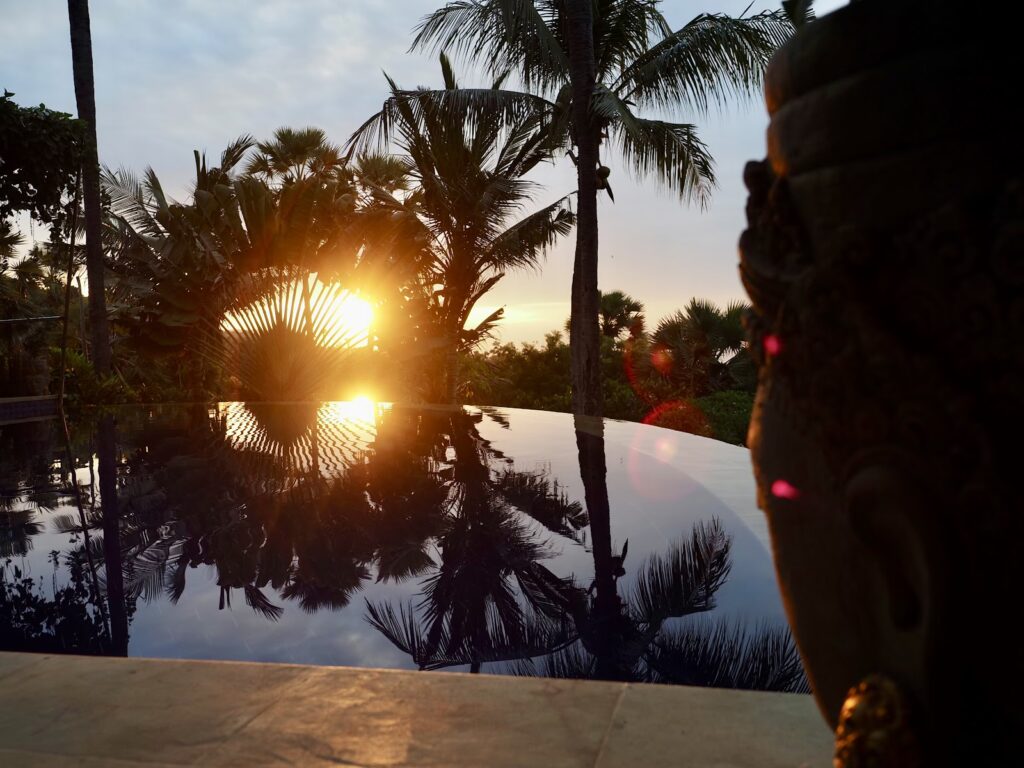
    Just a sunset reflection in the swimming pool beside our bedroom.

    In Bali, online booking apps quickly became our best friend, offering great last-minute deals on surprisingly lavish stays—many with breakfast included, plus extras like swimming pools, beautiful views, and, of course, blessed air-con. We could usually book the same day or just a few days ahead.

    Even during peak tourist season, the island seemed to have more rooms than visitors. Rarely did we miss out on our preferred choice, and we could often extend our stays on the spot. Hotels and restaurants alike were seldom full or overcrowded, which gave our trip an unexpected ease.

    💡Top Tip: We packed a lightweight, compact mosquito net that quickly proved its worth. Protecting ourselves not only from itchy bights, but also potential mosquito-borne illnesses was essential for a good (and carefree) night’s sleep— especially since many places didn’t provide nets.

    Bali Budget Breakdown 

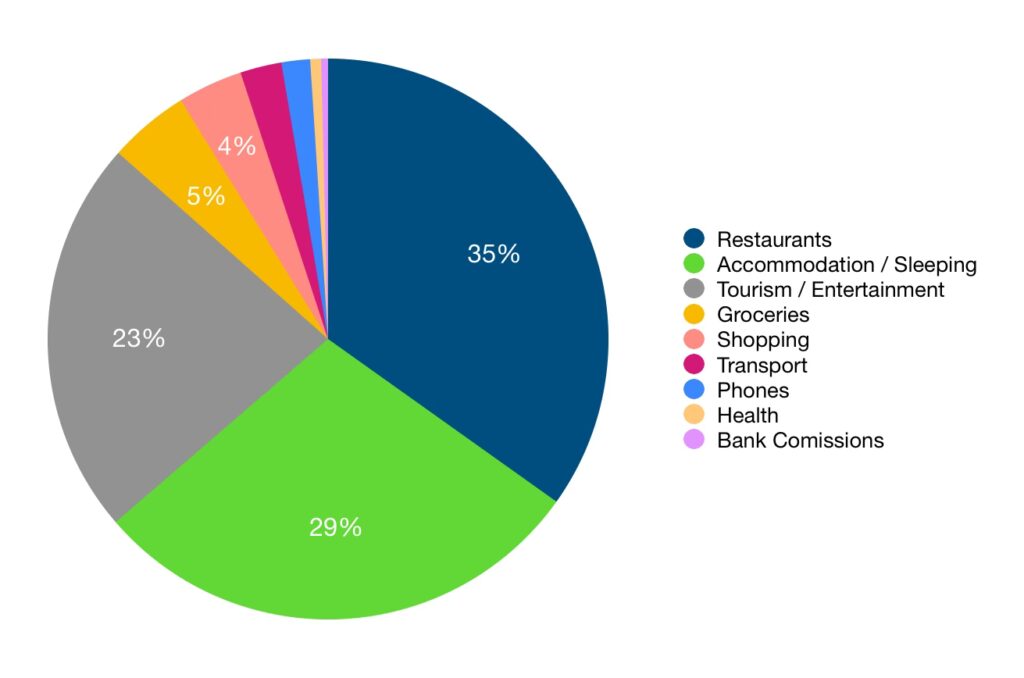
    💰Total average cost per month: 1.020€ (per person)

    We’d always assumed that once we reached Southeast Asia, our expenses would drop dramatically. We pictured saving heaps of money and maybe even travelling indefinitely. Bali quickly proved us wrong—though we do think it’s something of an exception in the region. Its popularity with tourists inevitably pushes prices higher.

    👉 Important detail: €200 each went toward our freediving courses and certificates, and that’s included in the total. Without it, our actual monthly spending in Bali was about €820 per person—of which 23% went to Tourism/Entertainment.

    One downside of losing our autonomy (no camping, no cooking) was that we had no choice but to pay for restaurants and accommodation daily. While still far cheaper than New Zealand or Australia, eating out three times a day and sleeping in homestays or hotels every night added up.

    The upside? Being a couple really pays off for accommodation. Single private rooms are rare—if not impossible to find—so the cost for the two of us was essentially the same as what a solo traveller would pay.

    Food & Drink

    In a nutshell: Nasi Goreng and beyond

    When it came to food, Indonesia quickly made things interesting. We arrived with little knowledge of the local cuisine but wide-open eyes and mouths, ready to taste as many new flavors as possible.

    The unofficial national dish here is Nasi Goreng: fried rice flavored with sweet soy sauce (kecap manis), topped with a fried egg, and served with cucumber slices and starchy crackers (krupuk). It became our early culinary “safe place,” but we knew that eating it three times a day wouldn’t keep us happy for long. We eased in cautiously, mindful of the infamous Bali Belly and other food-borne illnesses travelers love to warn you about.

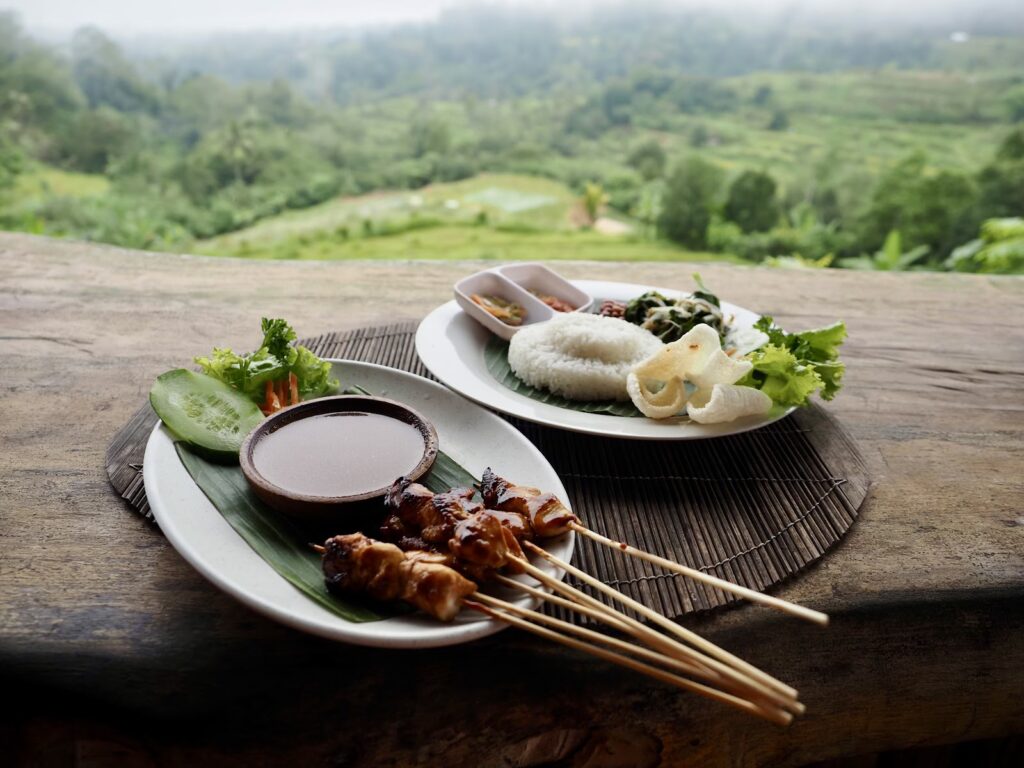
    Satay: Chicken or fish skewers served with peanut sauce and rice

    Breakfast required the quickest adjustment. Gone were the days of popping into a supermarket for our usual staples. Instead, we were at the mercy of our homestays or local cafés—where, more often than not, breakfast meant fried rice or fried noodles.

    Soon we began venturing further, discovering new dishes we didn’t regret (most of the time). Rice was almost always the star of the plate, with fried noodles as the main alternative—though these were often just packaged instant noodles dressed up with extras.

    We tried everything from local curries to grilled fish, from fiery sambal pastes to fragrant herbs and spices: lemongrass, ginger, coconut oil, chili, kaffir lime, sweet soy sauce, and other flavor-boosters unfamiliar to our European palates.

    A few favorites emerged—though, as always, the magic depends on where you eat them:

    Pepes Ikan — Fish grilled in banana leaves, marinated in a fragrant spice paste

    Perkedel — Sweet corn fritters

    Sambal Embe — Balinese fried shallot sambal (chili paste)

    Kare Sayur — Balinese vegetable curry

    When it came to coffee and tea, we had to scramble for new options. Our days of knocking back Barry’s Tea with a dash of milk were officially over. Conor, a devoted espresso drinker, began hunting for good coffee in Bali. Some cafés delivered beautifully—serving locally sourced volcanic beans with rich, complex flavours. Others offered “Balinese Coffee” (Bali Kopi), essentially a big cup of disappointing brown sludge.

    We also saw many places serving Luwak coffee — a local specialty made from coffee beans that have passed through the digestive system of civet cats — but given the ethical controversy around animal treatment, we decided not to try it.

    Alina, a non-coffee drinker, was pleasantly surprised that Matcha here was not only of high quality but also widely available, so she happily explored the world of green matcha delights on a regular basis.

    Route Planning & Navigation

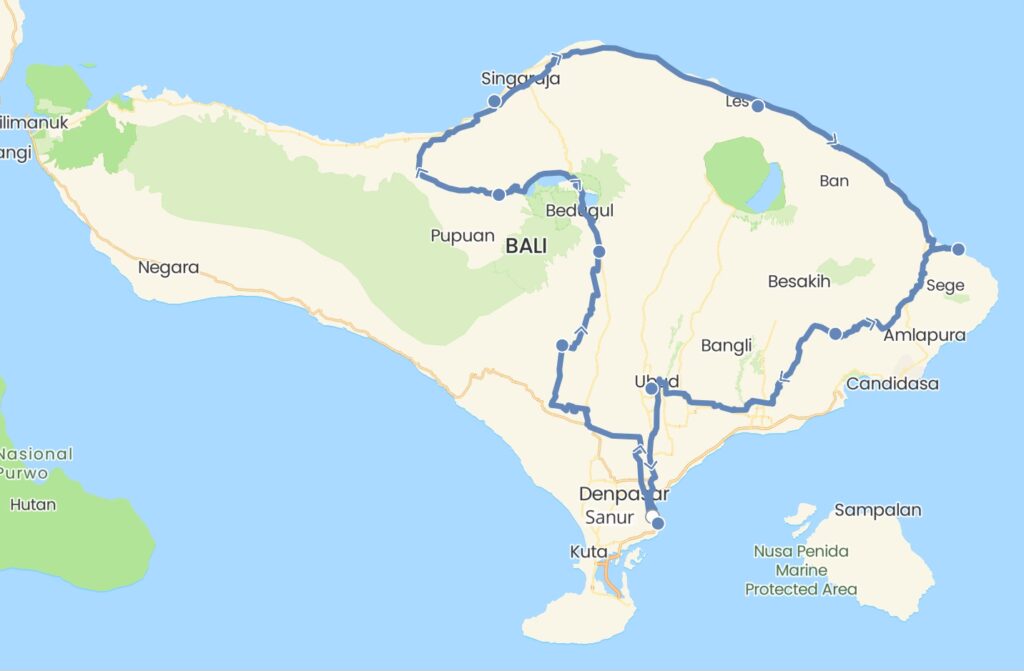
    If you take a closer look at a detailed map of Bali, you’ll notice most roads run vertically—from north to south—with very few horizontal routes crossing the island. At first, this felt limiting and confusing to us. It also kept us from venturing further west since that would have meant cycling the entire loop on the main road, which we feared would have too much traffic, especially toward the neighboring island of Java.

    Instead, we settled on a modest loop: climbing all the way up Mount Bratan and then following the northern coast eastward. Our only definite waypoint was Amed—the easternmost point on the map below—where we planned to take our freediving courses.

    Our cycling route through Bali.

    The road layout made navigation fairly simple: either head straight up or down, or follow the coastline.

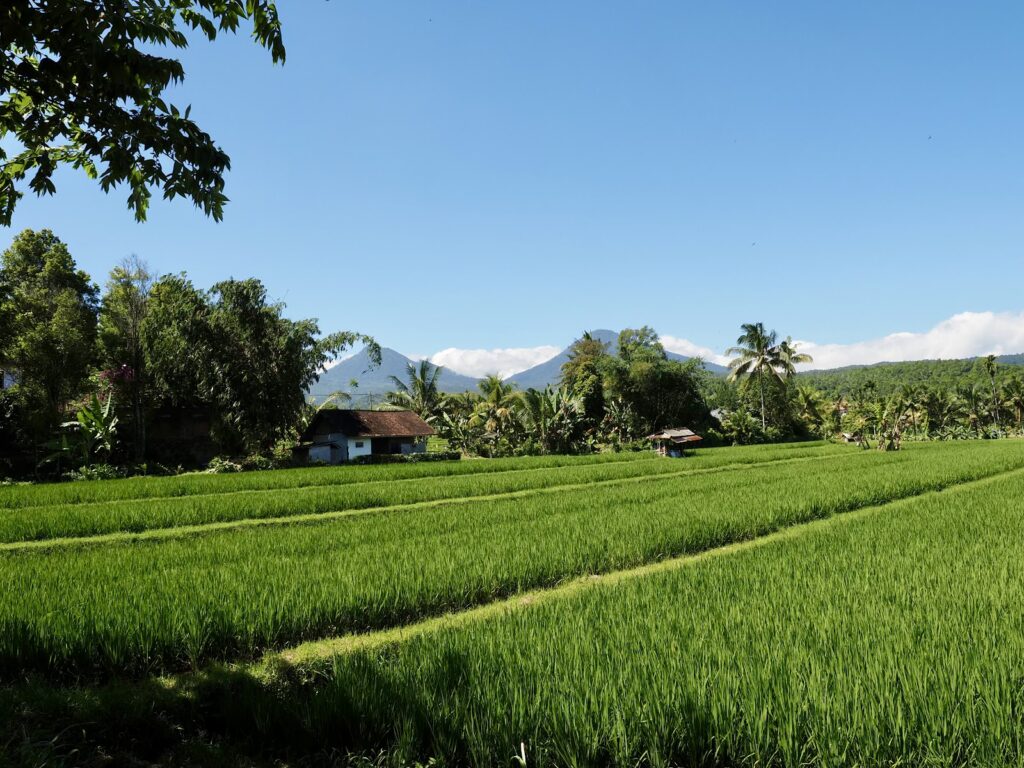
    Some stretches were a real joy—the luxury of winding down smaller backroads through rice paddies felt truly magical, especially on an island otherwise bustling with traffic.

    That said, it was a fine balance between stress-free exploration and constantly stopping to check the map. Missing a turn could mean retracing a long way since few roads cut across horizontally—so missing that one crucial crossing could add hours to the journey.

    Riding through the rice fields also meant tackling what we dubbed the “Devil Dips”—sudden, incredibly steep drops in the road followed immediately by sharp climbs.

    ⚠️ Cycling Safety in Bali

    At first, we were pretty apprehensive about cycling here. To us Westerners, the roads looked like chaos, with scooters buzzing all around. But surprisingly, this turned out to be the safest we’d felt on the road in a long time.

    The apparent mayhem actually works in your favor—the locals are incredibly nimble and skilled at dodging obstacles. Two-wheelers dominate the streets (mostly motorized), and larger vehicles tend to be smaller and move slowly. 

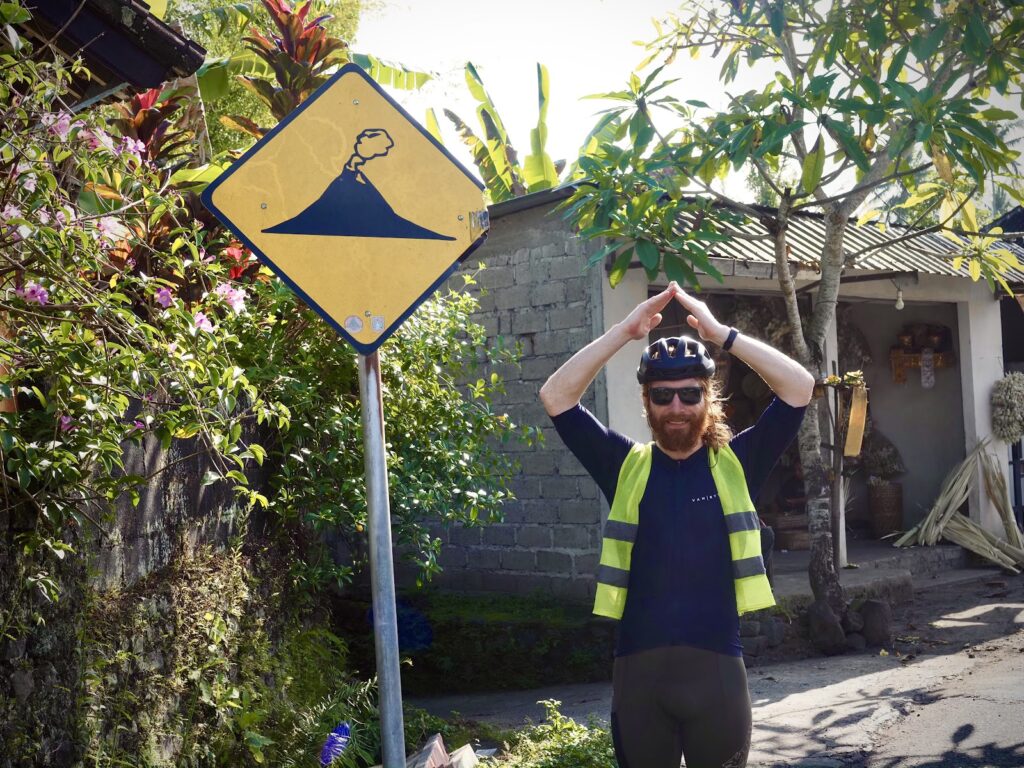
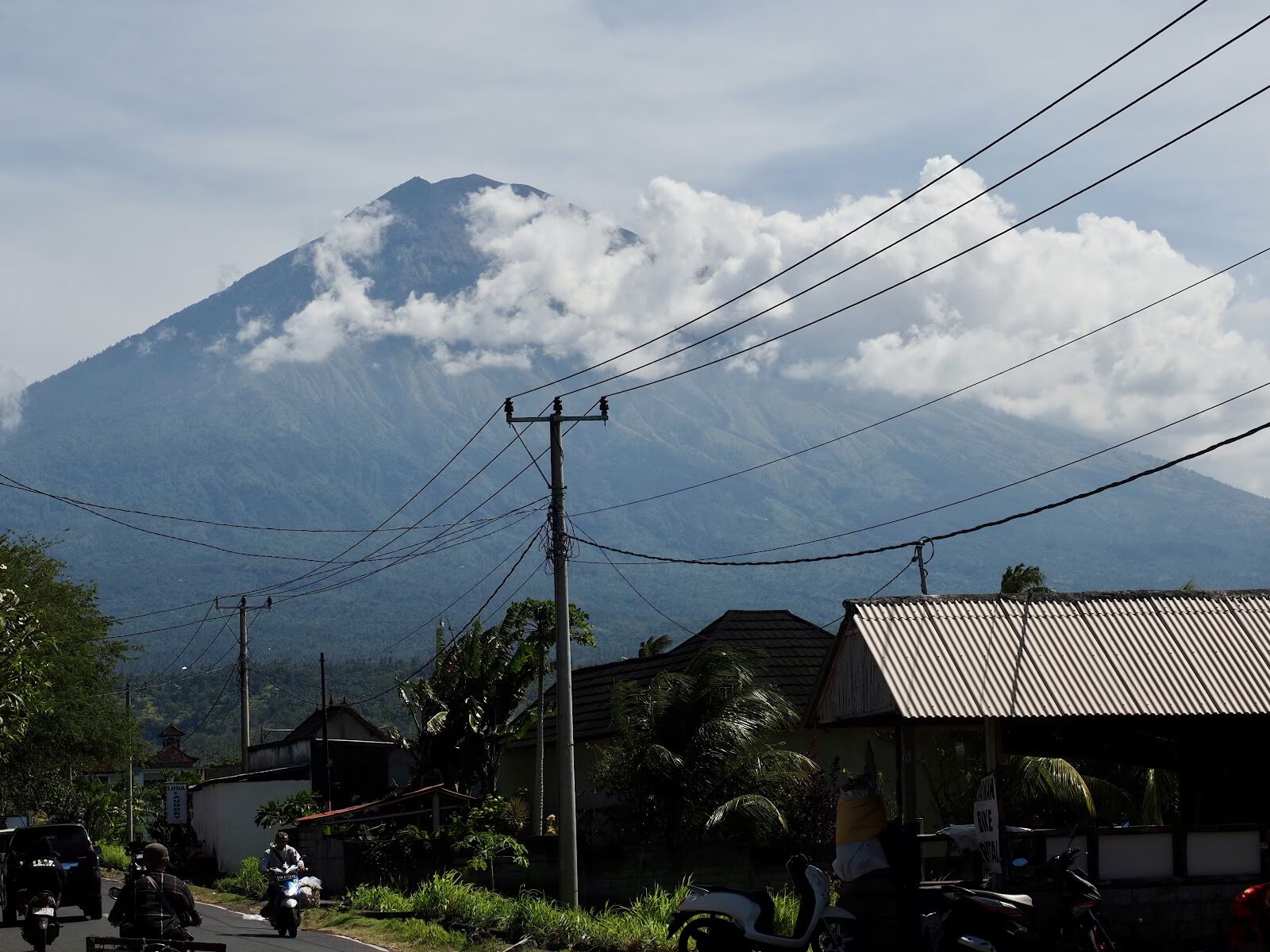
    Signs we encountered whilst cycling around Mount Agung— one of Bali’s active volcanoes.

    While not an immediate physical danger, one unpleasant and likely harmful downside is the exhaust fumes. They were relentless, especially when climbing steep slopes. Imagine struggling up a criminally steep hill—10 to 12% incline—in hot, humid weather, with endless traffic passing by, scooters, cars, and trucks choking the air with thick, black clouds of exhaust. These are the kinds of emissions that would surely be banned in many European cities today.

    We found no easy solution—wearing face masks while pushing up those inclines in the heat just wasn’t feasible. 

    Final Thoughts

    Bali is a nice island and we see the appeal of it, but we would not go back anytime soon, and we would hesitate to recommend it to anyone, bike tourists or otherwise.

  • Trying to Make Sense of Bali

    Trying to Make Sense of Bali

    Bali is one of Indonesia’s 17,500+ islands — yet it’s one of the very few most people can name. It’s relatively small, just 112 km from north to south and 153 km from east to west, but it’s packed with over 4.4 million people.

    Tourism here is massive, and accounts for about 60%-70% of the regional GDP. People come to Bali for all kinds of reasons: the tropical beaches, the food, the near-perfect surf, the cheap alcohol and parties, the yoga retreats and wellness clinics, the digital nomad lifestyle, the endless selfie spots to boost your Instagram feed, the five-star villas, the volcano hikes and waterfalls, the affordable dental work, the diving and coral reefs, and of course the Hindu temples that are scattered all over the island.

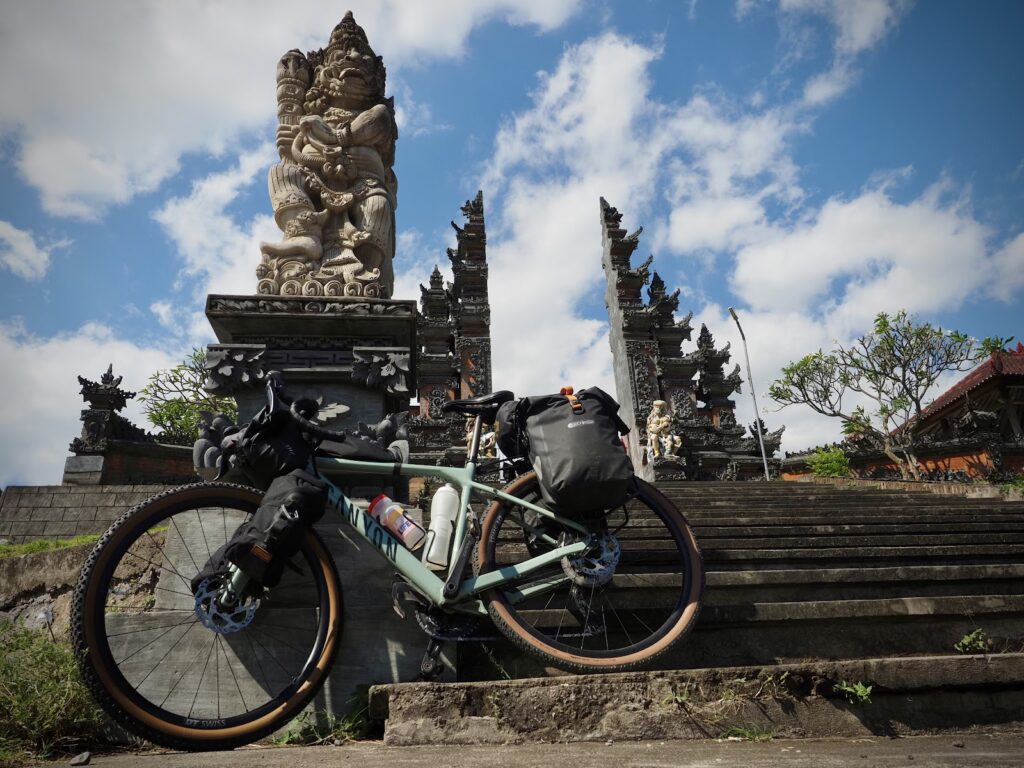
    A classic gateway to one of the many Hindu temples we cycled by.

    But why were we here?

    Honestly… because the flights from Melbourne were cheap. And because we’re still trying to forge our new identities as cool, sexy, clever, and culturally-aware explorers of the world — still desperately reckoning with our own self-image as travelers, not tourists.

    Maybe a bit of adversity would help us build some credibility. Maybe cycling through Indonesia would earn us enough cultural capital to hold our own in the right kinds of conversations.

    You know the ones.

    The ones that are whispered in underground cocktail bars.

    The ones that unfold in Paris cafés or around the vegan buffet at a climate action convention.

    The ones in which someone casually quotes a poet, and everyone else nods along.

    The ones the beautiful people have on the green carpet at the latest sustainable fashion brand activation.

    The ones where people effortlessly hold court in their second or third language — and where, even though no one admits it, everyone’s waiting for their moment to casually and skillfully drop a detail that signals: I belong.

    “Oh, you know that reminds me of a time I was bikepacking through Indonesia. It was raining, and I had no money — because you know I’d recently realized that currency is just a social construct used by the ruling class to maintain power. Anyway, earlier that day I’d gifted my tent to an Indigenous woman, so I had nowhere to sleep. — I knocked on the door of a local family and they took me in for the night. They taught me how to cook their traditional food. It was such an authentic, unique experience — you know, the type you could never find out about in a generic travel blog. — The thing about Indonesia is that the people there have so little, but they’re so happy. It really makes you think about how sick our society is.”

    That kind of conversation.

    We’re still not entirely sure what brought us to Bali. But once we arrived, we dipped our toes into a bit of everything — just to see if any of the reasons people come here would actually resonate with us.

    We started off in Sanur, a small town/resort to the east of the capital Denpasar. Think of it as a sort of holding pen for tourists, where they can acclimatise to the culture before they venture out to view the rest of the island, or in many cases they just stay there.

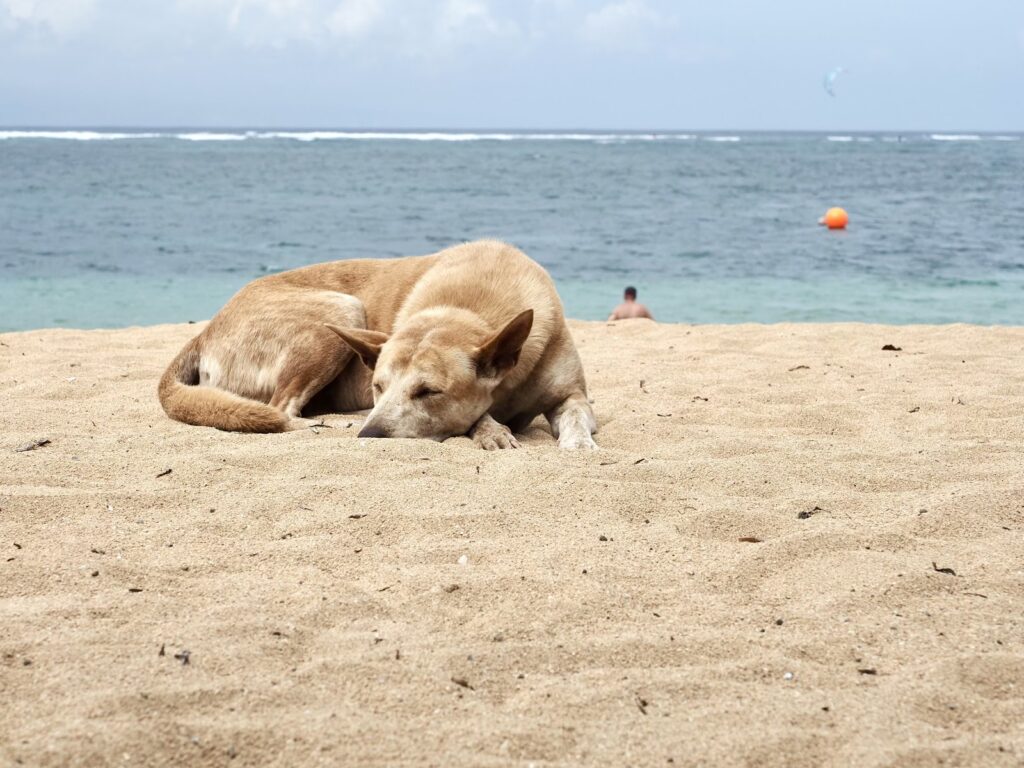
    A dog relaxing on the beaches of Sanur.

    To be fair, we didn’t see a single incident of drunken hordes of Australians working on their tank top tan lines that we were warned about. They were definitely on the plane over with us, but once we left the airport, we somehow got segregated. They went their way, and we crammed our bikes into a taxi and went ours.

    We decided this was a good time to relax before we hopped on our bikes, so we consumed some relaxation and outsourced all of our usual tasks. No more cooking, no more cleaning, no more worrying. Except we were still worrying — worrying about not brushing our teeth with the tap water, worrying about the heat, worrying about foodborne illness, worrying about how the hell we were going to navigate the raging river of scooters that they call a road.

    We needn’t have worried about cycling amongst the traffic. The scooters have a way of flowing around you that’s really quite pleasant. The rules of the road are few and subjective, but there’s a sense of collective understanding. We were part of the mayhem, as opposed to the cause of it. In NZ and Australia, we’d been terrified by massive trucks hurtling past us. But here, we were constantly amazed by how much more could be carried on a scooter. Want to transport a few 2-meter planks of wood? No problem. A thousand eggs? Sure. A family of four? Absolutely, just throw it onto the back of the Honda Scoopy and go.

    Once we left the sprawl of Denpasar and glimpsed the first rice paddies, we had the fleeting feeling that we were entering the real Bali — the parts that no Western eyes had ever seen before. That feeling lasted about two minutes. Tourism was everywhere. We couldn’t escape it. And no matter how different we felt, we were not different. We were just another flavor of tourist.

    We did not grow tired of the lush views of rice fields.

    So we leaned into it. We booked ourselves some picturesque accommodation and spent a night or two in an isolated wellness bubble, to see if we could purchase any more relaxation to help us cope.

    A few days in, we were still smiling, still enjoying the local food and the eternally happy people. We even found time between our relaxation appointments to visit a butterfly sanctuary. The sanctuary delivered some excellent content — enough to sustain our instagram stories, and if we played our cards right maybe even a full reel.

    The days passed and we still hadn’t lifted a finger. Everything was cheap and easy. It was the good life. And yet — something wasn’t quite right.

    After a non-insignificant mental episode and a noticeable dip in our moods, we hypothesised that we’d lost our sense of agency and that it was starting to affect us. We weren’t doing anything for ourselves. We were like fat children in pushchairs. And it couldn’t continue.

    So we made a decision. On the spot, we booked flights to Ho Chi Minh City, cutting our time in Indonesia short by four weeks. That meant forfeiting our exit flight to Singapore and cancelling plans to visit Lombok. But giving ourselves a tighter timeframe sharpened our focus — and we immediately felt vindicated.

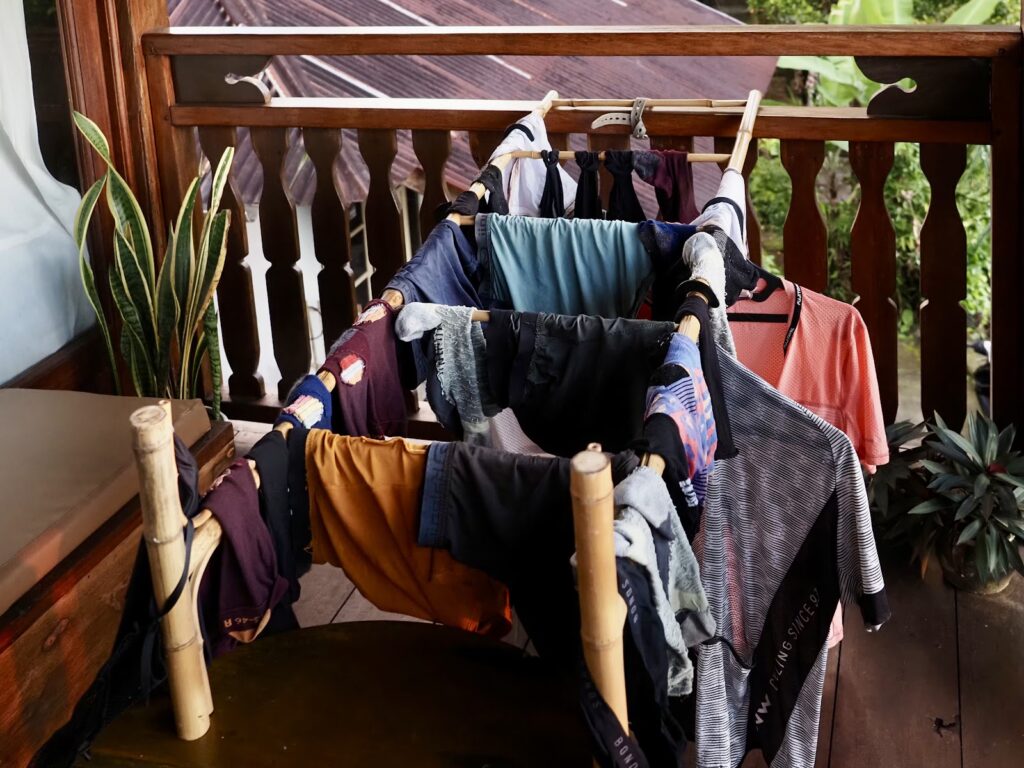
    Reclaiming our autonomy by hand-washing our clothes in the bathroom sink.

    Once we recognized our loss of agency, we could look at our Bali experience with new eyes. We reconnected with our “roots” as smelly, unkempt bicycle tourists and pedalled north with a renewed sense of self.

    It wouldn’t be long before we were back to doing nothing for ourselves — but at least now we were aware of it. We were also enjoying long stretches of being the only white people around, which reinforced our self-image as “adventurers,” boldly going where the masses had not. We felt so adventurous that in the seaside town of Amed we decided to take a freediving course — it was the kind of thing that you feel like you have to do while the opportunity is there. It was not exactly in our budget but we felt a sense of pressure to take advantage, knowing full well that back home it would simply be too much of a financial risk.

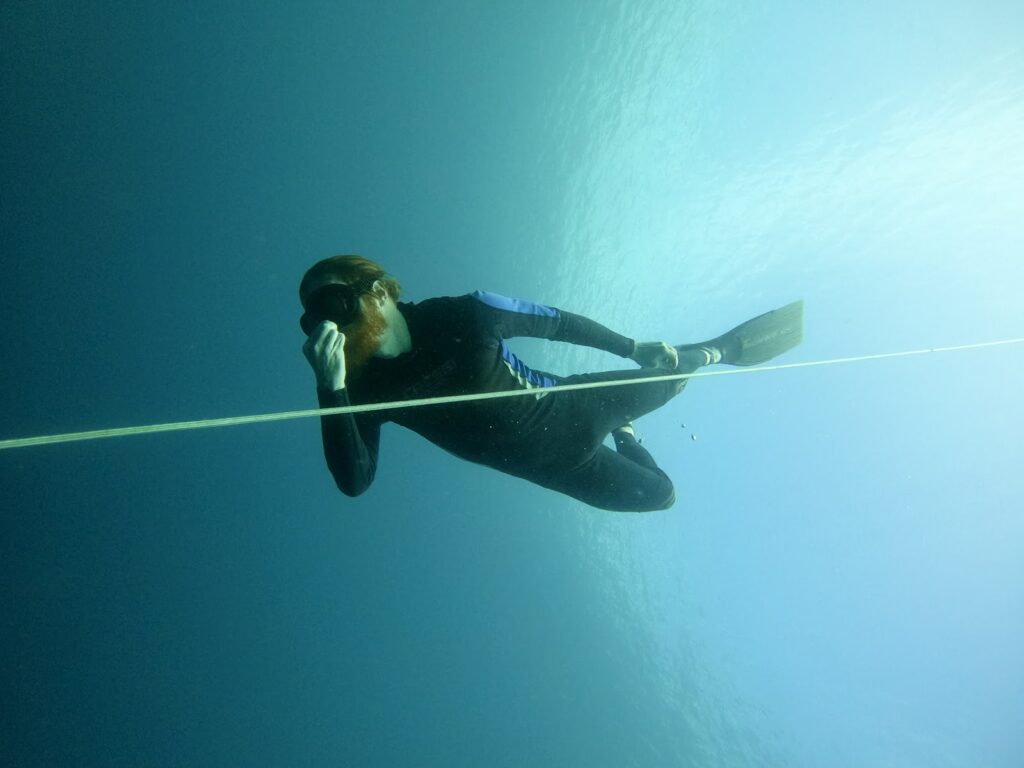
    During the course we learned to hold our breath and dive safely underwater. Alina discovered she had the superpower of equalizing her ears at will, while Conor struggled to pop his. But it was fun — and the kind that we would never do if we were at home.

    Conor on his way into the depths of the ocean (and attempting to pop his ears).

    This affordability is a double-edged sword. On one hand, we could stay in amazing accommodation, try freediving, and eat out every night. On the other hand, we saw the shadow side — like when we foolishly signed up for a “sunrise dolphin viewing experience.”

    When our host casually asked, “Do you want to see dolphins in the morning?” We enthusiastically said yes. We imagined something quiet and meaningful, just us a few playful dolphins and the fresh sea breeze. We woke up at 5:45am and walked 10 meters from our beds to the beach. It turned out we weren’t alone. This wasn’t the boutique experience that we were expecting. We were squeezed into a tiny fishing boat with a few other drowsy tourists and off we went in search of some local dolphins.

    The boat took off just after sunrise. It was peaceful — for a moment. But as the light grew, so did the fleet. Hundreds of boats crowded the water, all racing to find and surround the same pod of dolphins. It wasn’t an encounter. It was a hunt.

    The dolphins swam in frantic arcs, clearly trying to escape. Each boat jostled for a better position, chasing the pod every time they surfaced. It was stomach-turning.

    We came back to land feeling frustrated, ashamed, and confused. But what could we say? As long as people pay for that kind of experience, it will exist. Who were we to judge? All we could do was be more skeptical of such offers going forward— and acknowledge that our values would keep being challenged.

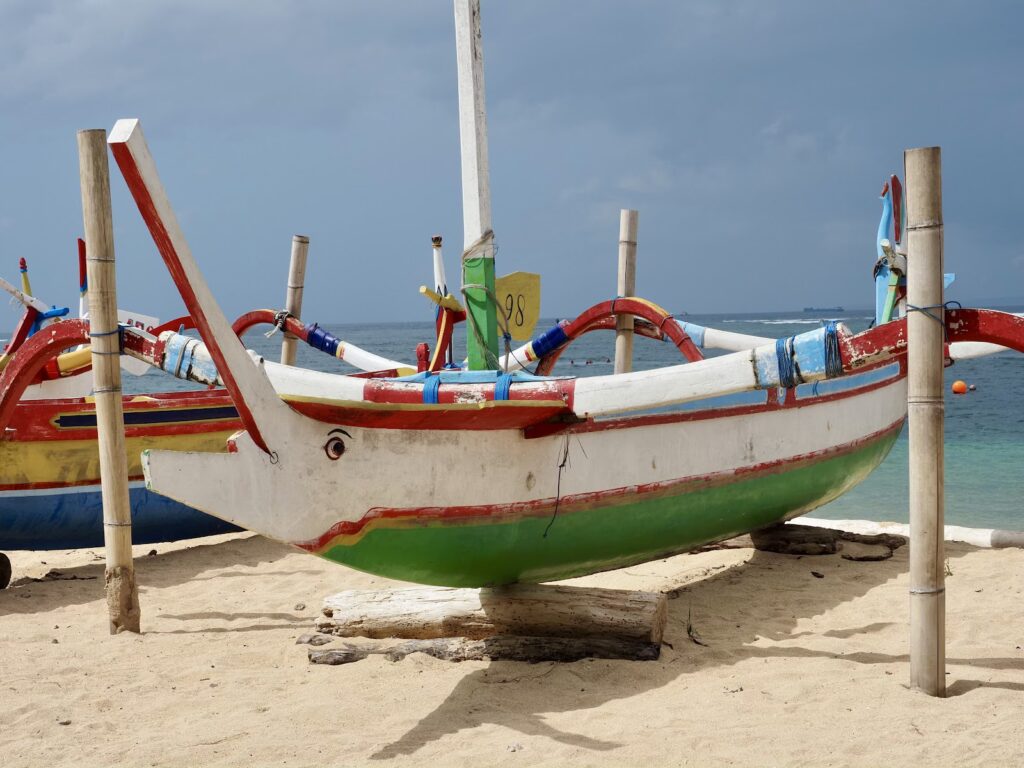
    Small motorized fishing boats took us out to see the dolphins.

    Of course, having your values challenged is part of living the unsheltered life. One of the more challenging moments came when we slowly, and somewhat embarrassingly came to realize that the smoldering piles of ash that we were passing on the roadside weren’t “offerings to the gods,” as we’d guessed. They were in fact flaming mounds of plastic — rubbish tossed into ditches and set alight as a crude form of waste management. Thankfully, our freediving course came in handy — we could now hold our breath long enough to pedal through a plume of burning plastic without gagging.

    However once you notice it, you can’t unsee it. Or unsmell it. The burning plastic became part of our days — a low, acrid haze in the air. At first, it triggered outrage. Then discomfort. Then resignation.

    To be fair, in many places, open burning is seen as the lesser evil. When the alternative is dumping waste into rivers or the sea, fire becomes the most immediate — if toxic — solution. To make matters worse, the plastic that was spared from the fire had a habit of finding its way into the rivers and coastlines. We cycled past waterways choked with debris and beaches where plastic bags floated like jellyfish. It’s easy to judge until you realise how few options exist in communities with no proper infrastructure and how overrun they are by tourists.

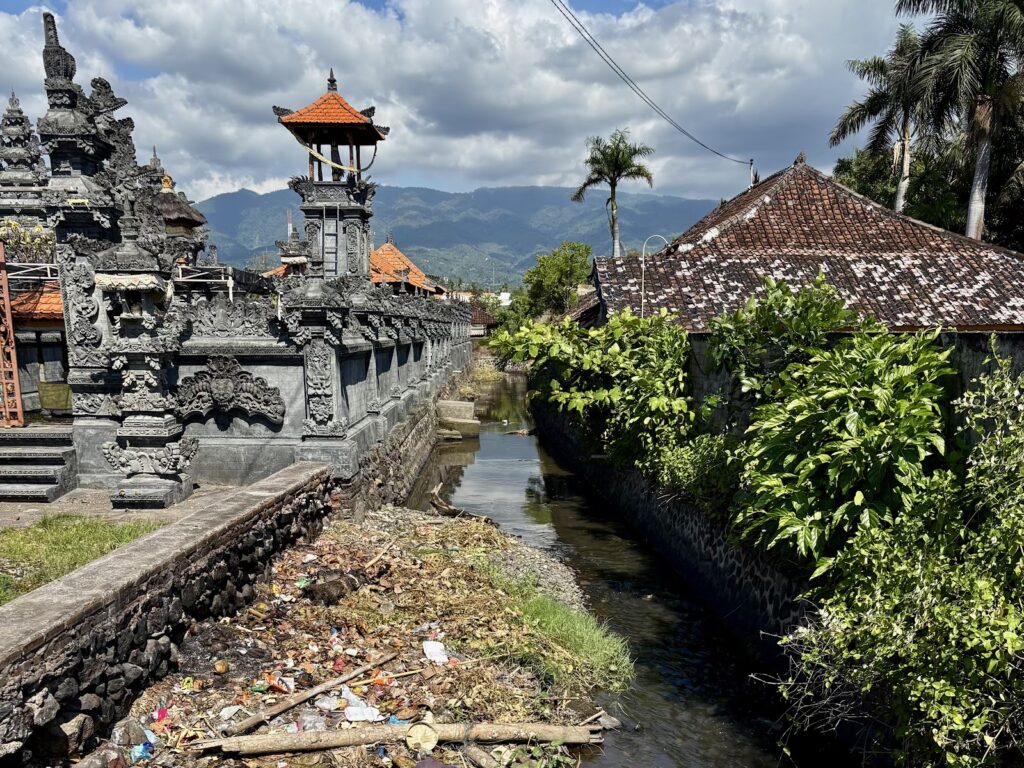
    Next to a Hindu temple, a river is clogged with rubbish.

    And still, we weren’t innocent. We left behind plastic bottles in hotel rooms, food wrappers in restaurant bins, never stopping to think what would become of them, just hopping back on the bikes and blissfully cycling away. It was a case of out of sight, out of mind. Whilst simultaneously condemning a problem we quietly contributed to.

    Yet amid the smoke and litter, we also saw something else: a radically different relationship to material things.

    In the same streets where rubbish burned, people reused and repaired everything — not as a lifestyle, but as a necessity. Plastic containers became plant pots. Inner tubes became bungee cords. Broken furniture was fixed rather than replaced. Nothing was wasted without a fight.

    Back home, we spend hours sorting, cleaning, and drying our recycling — but wouldn’t hesitate to throw out a glitchy toaster or replace a phone that feels “a bit slow.” An electrical fault back home means the end. Here, it just means a repair.

    It struck us how often “sustainability” in wealthier countries is performative — a curated set of habits that coexist with a culture of convenience. Meanwhile, in places with far fewer resources, frugality isn’t a virtue reserved for the environmentally conscious.

    Moments of relaxation at one of our lavish accommodations.

    So why were we in Bali? We came to Bali to distinguish ourselves from the tourists and prove our worth as travelers who can navigate strange lands with ease, and rub shoulders with the common man. We weren’t buying souvenirs or engaging with the obvious consumerism, but we were trying to purchase something, a version of ourselves. Something we could extract from the island and use to shape our own identities, and in that sense, we weren’t so different from the people we were trying not to be.

    Bali is whatever side of it you choose to see. If you want beaches, you’ll find beaches. If you want temples, parties, budget enlightenment, healing retreats, or Instagram reels with the perfect backdrop — they’re all here, ready to be consumed. The island adapts to your gaze. But what’s easy to overlook is that the flexibility comes at a cost. For every curated experience, there’s someone behind the scenes making it possible — often with little choice in the matter. The island gives and gives, but it’s not without consequence. How you view Bali depends on what you choose to see. The question is: what are you willing to ignore?

  • Tasmania & Melbourne: Our Final Recap

    Tasmania & Melbourne: Our Final Recap

    Those of you who have been following us already know, our second chapter was significantly less defined by cycling and more by our Workaway experiences. What we thought would be a convenient pit stop on our way to Southeast Asia—and a cheaper way to travel—quickly became one of the most enjoyable, educational, and wholesome parts of our journey so far.

    Choosing Workaways for our time in Australia was definitely driven by budget, but it turned out to be an incredible discovery on so many levels. We’re really glad we did them—for the connections, the learnings, and the inspiration we were able to take with us.

    Two months in Tasmania and almost a month in Melbourne flew by. We easily could have stayed longer, thanks in large part to the company of new and old friends that made it hard to leave.

    Curious how our new travel style impacted our daily habits and expenses? Here’s a breakdown of our stats for this stage of the Tour du Monde.

    Our Bike Touring Stats – By the Numbers

    In Tasmania we only spent a total of one week on the bikes, but we enjoyed every bit of it. 

    🚴‍♂️ Total Distance Cycled: 400 km
    ⛰️ Elevation Gained: 4.450 meters
    📆 Total Days of Cycling: 7
    🛠️ Number of Punctures or major Mechanical Issues: 0

    Fun fact: Even though New Zealand had a lot more total climbing and distance, Tasmania actually had more elevation gain per kilometer — meaning our days were far fewer but steeper and punchier.

    Accommodation & Sleeping Arrangements

    We only camped in our tent once during our entire stay in Australia. But we also only paid for accommodation for five nights—a big change from New Zealand.

    We experienced all kinds of setups. In Melbourne, we spent nearly a month staying with friends and loved every moment. It was a total luxury to have a spare room, good company, and the chance to feel at home despite being so far from it.

    Our humble home for about three weeks at the Strawbale House Workaway.

    Our Workaway stays brought even more variety: bell tents, camper vans, spare rooms, and hand-built earthen structures—each cozy and unique. One takeaway? We realized how little space we really need to feel comfortable.

    Budget Breakdown 

    💰Total average cost per month: 975€ (per person)

    So… how did we still spend this much when we were getting food and accommodation for free half the time?

    1. Australia is expensive—and Melbourne has really good food. We couldn’t resist.
    2. We spent a lot on new bike parts and a full service before heading to Southeast Asia. This totalled 940 euro for both bikes.
    3. We had to pay for some missing vaccines before our next leg. This totalled 340 euros for both of us.
    4. Transport costs were higher thanks to the ferry to and from Tasmania.
    A break down of our total spending of 5840 euro for both of us.

    After almost 5,000 km of riding, our bikes needed some love. We brought them to Off Course Bikes in Melbourne (highly recommend!) for a full service: new tyres, new chains, new cassettes, fine-tuning, and a few essential spares. A painfully big chunk of our budget, but worth it.

    Food & drinks remained our biggest expense at 43% of our total spend—even with free meals for half the trip. Melbourne was full of culinary temptations, and we leaned in.

    A small note: Cash is barely used in Australia—even less than in NZ. We took out cash early out of habit and struggled to spend it toward the end!

    We didn’t save as much as we hoped—but we have no regrets. The money went to what matters: good food and healthy bikes.

    Food & Drink

    In a nutshell: Toasties, Parmis, Pies and Ice cream. 

    We didn’t expect a culinary revolution coming from Australia, but we did discover Parmis—a chicken schnitzel layered with tomato sauce, cheese, and chips. Sometimes with gravy, seafood, or pineapple. Think Cordon Bleu meets pub classic. Massive and indulgent.

    A Parmi in Australia seems to be the equivalent to a pie in New Zealand, almost always readily available and a popular pub grub. We were greeted with amazed looks by the bartender when we ordered a Parmi and we said it was the first one we ever had.

    The remains of a giant Parmi was a great lunch snack on the bicycles.

    On the flip side, Melbourne was a food heaven. World-class restaurants and cafés on every corner. A strong Asian influence, and too many good places to choose from. The real challenge? Forcing ourselves to try new spots instead of returning to favourites. Thankfully, our amazing hosts helped guide the way to mouthwatering sandwiches, soul-warming bowls of Ramen, liter tubs of yummy ice creams and so much more.

    Between that and the Workaway meals, our camping stove barely saw the light of day in Australia.

    Route Planning & Navigation

    Cycling was never meant to be the focus here. We deliberately took time off the bikes during Tasmania’s colder, wetter winter, opting instead to shelter in our Workaways during the shorter winter days.

    In Melbourne, our movement was mostly limited to Smith Street, just east of the Central Business District, where we stayed with our friends. Honestly, we didn’t need to go far. Smith Street had everything. That said, we did make the odd trip to the Botanical Gardens, ran some errands in other parts of the city, and took a few rides downtown.

    Our route through Tasmania, including car rides and cycling,

    In Tasmania, we originally planned a cycling loop between Workaways. But thanks to generous ride offers from hosts and extensions at some stays, we ended up traveling more directly, skipping both the east and west coasts.

    The first few days followed the Tasmanian Trail—gravel tracks, forest roads, and occasional questionable fence crossings. The final leg was over the Central Highlands, on a lightly trafficked road. Coming into Hobart, we were thrilled to find a 14 km cycle path called the Intercity Cycleway leading right into the city. All in all we had no navigation challenges.

    Map legend side note: No, we didn’t hitchhike the traditional thumb out way—those rides marked on our map were generously offered by our hosts. Thanks to all the big vehicles, it was always easy to fit us and our bikes in the back.

    ⚠️ Cycling Safety in Tassie

    We had high hopes. Early on, drivers gave space and seemed cautious. We thought maybe dodging wallabies at night made Tassie drivers more attentive, alert and reactive.

    But as we got closer to the capital Hobert we noticed that Tasmanian drivers were just as reckless, or even more so than NZ drivers. Witnessing outrageous maneuvers, like cars coming from behind us and making zero attempts to slow down, causing oncoming traffic to come to a complete halt or having to veer off the road. Thankfully our time spent on the road was kept to a minimum.

    The wombat in its natural habitat.

    Final Thoughts

    Tasmania and Melbourne became very dear to our hearts for many reasons. All the stars seemed to align for us here, as we made beautiful connections, upskilled in areas we were interested in (natural building, permaculture and handy skills) and got to witness the wild Tasmanian countryside. Melbourne was like a dip into a city honeypot— we were able to indulge in all the great things a city has to offer and got to spend quality time with friends. 

    We’d love to return to Tasmania for more cycling (once we’ve forgotten how hilly it was). It might not have been the cheapest chapter after all, but it was one of the richest—in every way that matters.

  • Tasmania: Working Away on Two Wheels

    Tasmania: Working Away on Two Wheels

    It’s 6:30 am and we’re in a tiny town in the Tasmanian countryside called Gretna. We wake up in a warm bubble of sleeping bags, every bit of us carefully tucked away. Staying curled up in our little tent, wrapped in merino and down layers, sounds pretty ideal—but the truth is, we’re groggy and disgruntled at waking up at such an ungodly hour, and very aware that the urge to pee isn’t going anywhere, so we might as well face the sub-zero outside world.

    As we unzip the tent, we’re met by a stiff, frozen tent fly—condensation turned to ice overnight. Our breath hangs in the air, and everything around us is coated in a silent frost. It’s freezing, but eerily beautiful. Numb fingers and toes push us into motion. Camp comes down quickly, and after a bowl of cereal and a hot cup of tea, we’re back on our bikes, pedaling out of the highlands and south toward Hobart, Tasmania’s capital.

    A frosty morning covered our bikes in a white coat.

    Tasmania marked a clear departure from the rhythms we had formed in New Zealand. By now it really felt like winter and, in comparison, we were barely cycling—spending more time working than wondering. We’d even picked up some extra clothes to suit our new lifestyle as casual, unskilled labourers. The added weight and bulk meant that when we did get back on the bikes, we felt every hill and every kilometer seamed that little bit longer.

    After finishing up at our first volunteering gig, we made our way to the remote valley of Lorinna. Nestled in dense native forest, Lorinna was originally a gold rush town but was resettled in the 1970s by ambitious hippies and remains a haven for off-grid, alternative living. We stayed there for two weeks with a family of four in their beautiful, self-built home. The property was dotted with tiny cabins that formed a kind of deconstructed house: the kitchen was in one building, bedrooms in another, and the bathroom elsewhere—each one connected by a thriving, productive permaculture garden.
    A bountiful harvest of Tromboncino at the permaculture Workaway in Lorinna.

    The garden was abundant—but also demanding. That’s where we came in. Our duties included chopping wood, weeding, digging veggie patches, pruning fruit trees, cooking meals, and planting trees. The valley of Lorinna felt like a very small self-contained breakaway nation: producing most of its own food and all of its electricity, capturing rainwater, and coming together for bigger projects and shared community interests. It was both rugged and inspiring.

    After two formative weeks in Lorinna, we packed up again and headed to the even more remote region of Jackey’s Marsh. A chance encounter with the somewhat mystical Mira had landed us a gig house sitting and looking after horses while she and her partner Krishna took some time away from their property.

    Their home was like something out of a post-apocalyptic eco-manual—in the best way. Mira and Krishna had built an Earthship—an off-grid, sustainable house made from natural and recycled materials like earth-packed tyres, glass bottles, and cans. Designed to manage energy, water, and waste independently, it was a clever, low-impact way to live with the land.

    We were left to enjoy the quiet wilderness: just us, the wallabies, pademelons, wombats, leeches, hawks, kookaburras, possums, and two rather smart horses—Chief and Sánchez. It was peaceful, simple, and an opportunity to rest between Workaways.

    Chief munching away on his food.

    At this point, without fully realising it, we’d spent the better part of six weeks in Tasmania—but only three or four days on the bikes. With time running out, we decided to head south toward Hobart and our final Workaway on the Nicholls Rivulet Peninsula.

    We had a few options for the route: take the wild and wet west coast, the drier and more populated east, or head straight through the middle—across the Central Highlands and highland lakes. Pressed for time, we chose the direct central route. It came with more elevation and colder temps, but was by far the fastest option available to us.
    Day one kicked off with 68 km and 1,330 m of climbing. Our legs held up better than expected—it was our minds that faltered. After reaching the highest point, we convinced ourselves that it would be smooth sailing from there. Classic mistake. The final 20 km were flat and scenic, but felt endless. We crawled into the village of Miena cold and exhausted, grateful to check into a room for the night. It dropped to -7°C, and we had no regrets about choosing a heated bedroom over our tent.

    Cold and misty mornings on the Highland plateau provided beautiful scenery.

    The following day, despite a rocky start and a broken pannier hook (quickly mended with zip ties) we hit our first 100 km mark of the trip, helped along by a generous downhill stretch. We arrived in Gretna, a tiny town about 65 km north of Hobart. We had hoped to stay in the local hotel, but we discovered that (at least for tonight) it was more of a local watering hole, and plenty of bogans were crammed into the bar for a country music concert; we were clearly the outsiders. There were no rooms available, but they kindly offered us a patch on their lawn/carpark to pitch our tent. After a suspect pizza and a few beers, we left the locals to it. Then we quietly snuck away to our tent for the night.

    The next morning, we packed up early and made our way to Hobart, where we’d booked a discounted Airbnb to recover for a few days. While there, we rested, explored the city a little, and visited MONA (The Museum of Old and New Art)—which lived up to its reputation.

    MONA museum: A room filled with motor oil.

    Our final Tasmanian Workaway was with Clare and Gareth, who had bought a beautiful olive grove about twelve years ago and now produce their own olive oil. We arrived just in time for the annual harvest and got to be part of the full process: picking, pressing, and of course, tasting. The result? A vibrant, peppery green oil packed with flavour.

    We immediately felt welcome in their family home and quickly became fond of their giant, gentle Great Dane Daisy, as well as their two homeschooled kids (aged 7 and 10), who amazed us daily with their knowledge of woodworking, blacksmithing, and general trivia. In exchange for a few extra days of help, Clare and Gareth kindly gave us a lift back up north to Devonport, where we would catch the return ferry to the mainland.

    Daisy making sure we are harvesting the olives thoroughly enough,

    Tasmania was special—more than we expected. We knew it would be beautiful, but we didn’t anticipate connecting so deeply with the people and projects we encountered along the way.

    In just under two months, we learned more than we could have imagined: from natural building to permaculture, olive harvesting to off-grid living. We left feeling inspired, full of stories, and with a clearer sense of what might come after this trip.

    Thank you, Tasmania.

  • Tasmania: A House of Straw

    Tasmania: A House of Straw

    At the very early stages of our planning—before we even left Spain—we had booked an exit flight from New Zealand (as per our visa conditions) to Melbourne, in order to visit our good friend Podge and exploit his unwavering hospitality. We quickly pushed any further planning to the back of our minds and confidently said to ourselves, “We’ll sort that out later.”

    Australia is roughly the size of Europe and slightly smaller than the USA. It’s littered with animals and insects that we don’t understand—many of which could easily kill us if we got careless or complacent. For a while, we were scratching our heads, wondering how we were going to navigate Oz on our bikes. The major cities are far apart, and the train network isn’t much to write home about.

    It’s a well-worn trope that everything in Australia is rather hostile—be it spiders, wildfires, sharks, floods, bogans, crocodiles, snakes, or an orderly but aggressive kangaroo. Even worse, the seemingly harmless koalas could pass on chlamydia if you get too close.

    Truthfully, we were looking past Australia and merely viewing it as a barren, unmanageable stepping stone to Indonesia. Then one day, while squinting at a map of Oz, we spotted the bite-sized island of Tasmania (or “Tassie” to the locals), and the proverbial lightbulb went off in our heads. Done deal: we’d fly to Melbourne, leverage our friend for free accommodation, and catch the ferry to Tassie—where we could cycle freely and carelessly for the next two months or so. Easy as.

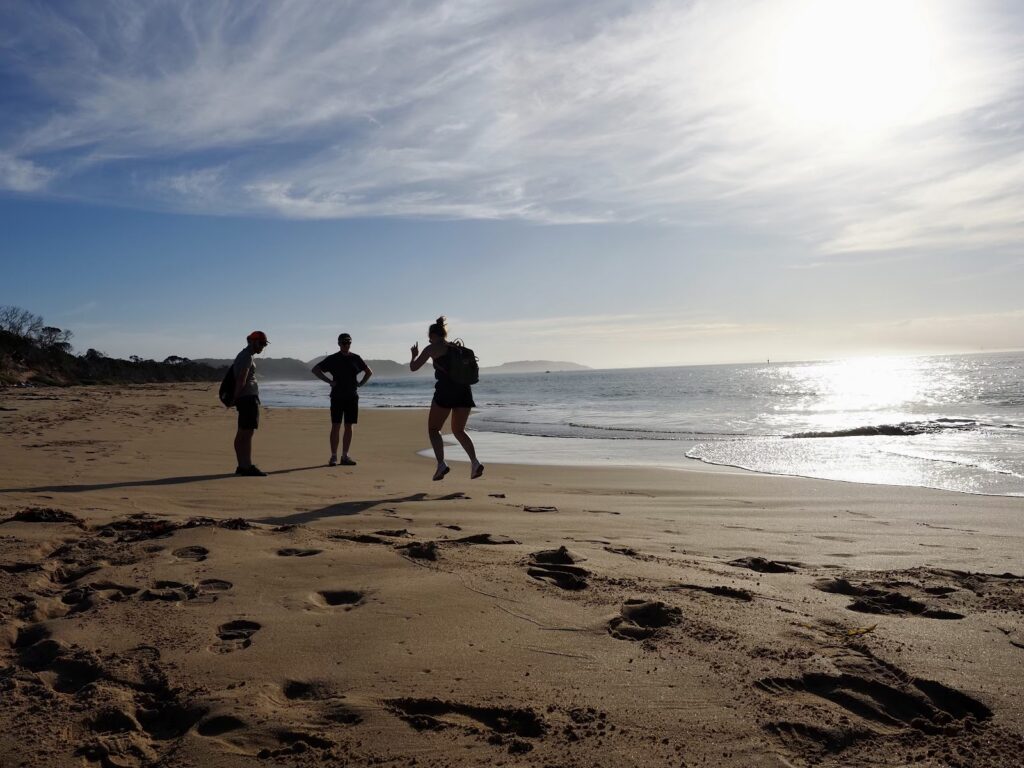
    A day trip with Podge & Clara to the Mornington Peninsula south of Melbourne.

    Having left New Zealand behind, it was time to start the next leg of our trip. Our plan—like most of our plans—was simple, loose, and only half-baked.

    After enjoying long Southern Hemisphere summer days for the past three months, it was becoming clear that the nights were starting to close in on us, and the cold wouldn’t be far behind. By this stage, it had also been pointed out to us several times that “Tasmania will be getting quite chilly at this time of year”—an ominous sign that cycling and camping might be a slightly mad undertaking.

    With that in mind, we decided to spend most of the next three months off the bikes. We lined up a few volunteering opportunities (via Workaway) that would provide us with free food and accommodation in exchange for our labour and our irresistibly charming personalities.

    Workaway is an online platform offering a host of volunteering gigs—from childminding and English teaching to fruit picking and dog walking. After tweaking a few filters to match our interests, we quickly settled on three hosts for our time in Tasmania. This would allow us to drastically reduce our outgoing expenses and, if we played our cards right, even develop new skills and knowledge in our areas of interest.

    Kangaroo’s in a park close to Melbourne. Tasmania is not home to the Oz native kangaroos, but instead you can find plenty of their smaller relatives: Wallabies and Pademelons.

    After a fantastic ten or so days in Melbourne, we boarded the train to Geelong and hopped on the ten-hour overnight ferry to Tassie.

    Drawing comparisons between New Zealand and Tassie was inevitable. They share a lot—but the wildlife in Tassie is a whole different story. Having honed our skills as amateur birdwatchers in New Zealand, we were used to scanning treetops, hoping to catch a glimpse of whatever bird we’d just heard singing in the distance. In Tassie, spotting wildlife is a non-issue. In fact, it’s harder to avoid the countless creatures hopping, flying, swimming, running, crawling, or sneaking all over the place.

    We had been pre-warned that the amount of roadkill in Tassie was off the charts—and it quickly became clear why. Even though it’s Australia’s smallest state, it’s one of the most densely populated when it comes to wildlife. There are so many animals rustling around on the roadside that hitting one or two in your ute is a near-weekly occurrence for many locals.

    According to some estimates, about 500,000 animals die on Tasmanian roads each year, making it the so-called “roadkill capital of the world.” On bikes, the smell of pulverized possums can be overpowering—but we managed as best we could. Just try not to rest directly next to a carcass and you’ll be fine.

    When our ferry docked in Devonport, we cycled for two days on the Tasmanian Trail southbound to Deloraine, where we were due to meet our first Workaway hosts.

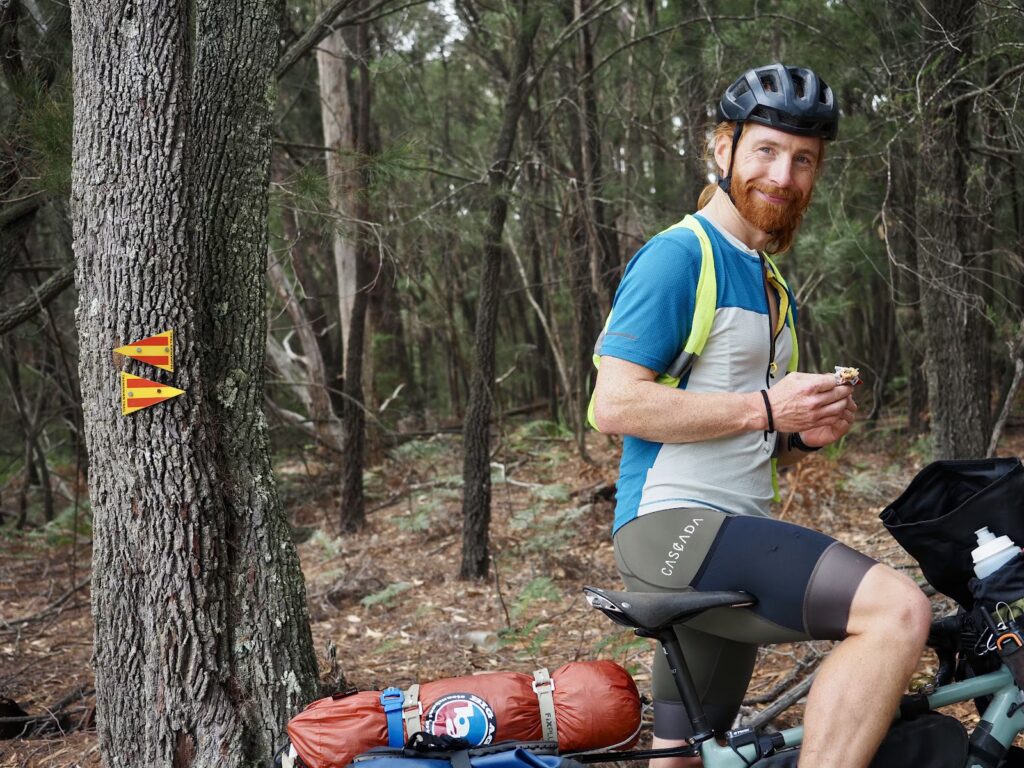
    Following the yellow and red markers for the Tasmanian Trail towards Deloraine.

    Our hosts Patrick and Rhianna are building a solar-passive, straw bale house and needed a few extra hands to help weatherproof it before the Tassie winter truly set in. When we arrived on site, the foundations were already laid. The wooden frame of the house was in place, straw bales were packed into the walls, and the roof was mounted and rainproof. However, there were still exposed gables and plenty of weatherproofing and airtighting measures that needed seeing to.

    We quickly learned a lot. The design concept was fairly straightforward: build an energy-efficient, airtight house that would rely on the sun for its winter heating needs, and use a pergola to block the intense Australian sun from entering the triple-glazed windows in summer. In theory, this would keep the house warm in winter and cool in summer—simply by managing solar gain.

    The heat retention from thermal mass of the concrete floor and the airtightness and insulation of the structure were integral to the success of the design. Patrick and Rhianna have so much faith in the concept that they don’t plan to install any additional heating or cooling systems—no fireplace, no air conditioning, no radiators.

    The sunny side of the house features big windows to let in the low winter sun and a timber pergola for growing leafy vines that will shade it from the higher hot summer sun.

    Their electricity would come from solar panels, and all water would be collected via a rain catchment system. The entire setup was built around responding to the local climate, harnessing the resources that fall from the sky, and limiting reliance on increasingly volatile global supply chains.

    This philosophy extended beyond the house. It meant growing as much of your own food as possible, developing the skills to fix most of your tools and appliances, and prioritising purchases that could be repaired using basic and widely available parts.

    The decision to build the walls with straw bales instead of bricks was especially interesting. Highly regarded by natural builders worldwide, straw bale construction has a low environmental impact, is readily available, easy to work with, and offers exceptional insulation & soundproofing—for a fraction of the cost of conventional building materials. From what we could see, it was a no-brainer—and vastly superior to the poorly insulated apartments of Barcelona that we had begrudgingly become accustomed to.

    The indoor plaster will be made of clay and sand; a sustainable alternative to conventional building methods.

    During our stay, we took on all sorts of tasks: installing battens and insulation paper in the gables, packing out holes in the straw with cob, mounting flashings for additional waterproofing, painting the flashings to avoid corrosion, and applying a full coat of exterior render (by far the biggest and most rewarding job of them all).

    But we didn’t just work. We were lucky to have fantastic hosts who we genuinely enjoyed spending time with. We had a pizza night, visited the local pub a few times, went platypus spotting (and yes – we got to see some platypus), and shared many great conversations.

    Thank you Rhianna & Patrick for being wonderful hosts!

    At the time of writing, we’re nearing the end of our stay in Deloraine at Patrick and Rhianna’s house—after extending our visit by a full week. We’ll leave with a bunch of new (and improved) skills, heaps of inspiration, and a much wider vocabulary and understanding when it comes to insulation, architecture, and natural building.

    It was a very pure and enjoyable exchange. We offered our unskilled labour and helped wherever we could. In return, they gave us free accommodation, good food, and—most importantly—free ideas that we’ll carry forward with us.

  • Cycling New Zealand: Our Final Recap

    Cycling New Zealand: Our Final Recap

    Thousands of kilometers, endless climbs, and more cups of tea than we can count—our time bike touring through New Zealand has come to an end and it was nothing short of unforgettable. From the rugged West Coast to the winding tracks through native rainforest, we’ve cycled through some truly breathtaking landscapes, battled many hills, met heaps of friendly people, and learned a lot about life on the roads of New Zealand.

    Now that we’ve wrapped up our time here and are reflecting on it while sipping tea Down Under, we wanted to share a final breakdown of our cycling journey—covering the numbers, our culinary discoveries, our route, and even what this adventure trip actually cost us so far.

    Our Bike Touring Stats – By the Numbers

    While we did engage in other activities during our visit to New Zealand, our main objective was to cycle. So here are the hard facts, numbers can’t lie after all:

    🚴‍♂️ Total Distance Cycled: 2,196 km
    ⛰️ Elevation Gained: 21,000 meters
    📆 Total Days of Cycling: 39
    🛠️ Punctures/Mechanical Issues: 0

    Accommodation & Sleeping Arrangements

    New Zealand is a country built for cars and campervans—everything from campsites to road infrastructure seems designed with motorised travelers in mind. For two cyclists with a small tent, this often meant we didn’t quite fit into the equation.

    Back in Europe, wild camping was usually straightforward. Finding a secluded spot off the road, setting up at dusk, and leaving no trace by dawn was second nature to us. However, in New Zealand, opportunities for wild camping were few and far between, and we didn’t want to push our luck.

    Most of the land we encountered was either fenced-off private farmland or dense, rocky, and steep bushland—neither ideal for pitching a tent. As a result, we mostly relied on official campsites, which, to be fair, turned out to be a great option.

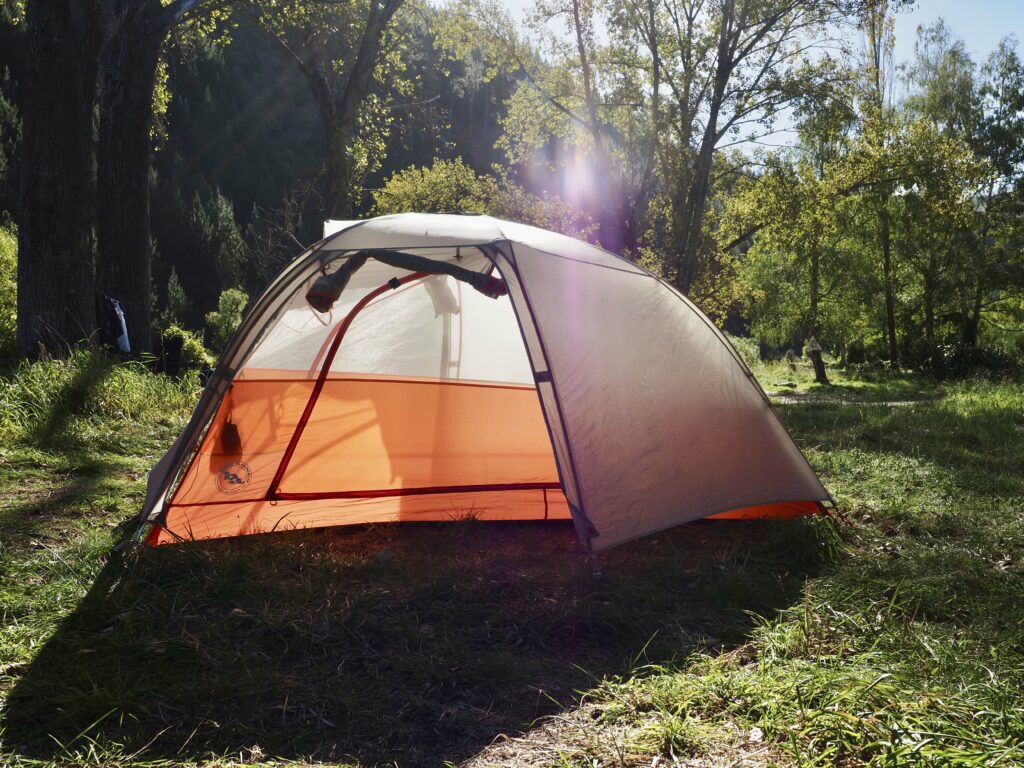
    Tent in the sun
    Our bed and home for the majority of nights.

    Our favorites were DOC (Department of Conservation) campsites, regularly scattered throughout the country, often in stunning national and regional parks. These sites were generally affordable (5-10€/person) and provided the basics—typically running water and a drop toilet—while offering a peaceful setting, often by a lake, river, or deep in nature.

    If a DOC site wasn’t an option available, our next choice was a privately run campsite or a Holiday Park. These tended to be more expensive, had more facilities (like showers and kitchens), but also meant more noise, people, and less privacy—a trade-off we accepted when needed. In towns, we occasionally opted for a motel or even treated ourselves to an Airbnb—a rare luxury but always appreciated for a proper rest day.

    Once we reached the South Island, we also started using Warm Showers, a hospitality network for cycle tourists (think CouchSurfing, but for cyclists). This turned out to be one of the highlights of our journey. We met incredibly generous hosts, shared delicious home-cooked meals, got valuable local tips, and—best of all—enjoyed a cozy bed after long days of riding. To any of our Warm Showers hosts reading this—thank you again!

    Budget Breakdown 

    💰Average cost per month: 1.200€ (per person)

    First, a couple of things worth mentioning:

    1. We spent about three weeks volunteering at Kiwiburn without spending any money.
    2. When we did spend money, we weren’t exactly counting our pennies.
    Pie chart of our expenses

    As you can see from our breakdown, over half of our budget (55%) went to food & drink in one way or another. Which makes us conclude that groceries in New Zealand are ridiculously expensive, or that we eat and drink like bottomless pits (probably both).

    Truth be told, we were not holding back from enjoying food, drinks and coffee on the road. A cost that we possibly could have kept lower, but did not necessarily want to.

    NZ has a supermarket duopoly—Woolworths and New World—controlling nearly every major store. This lack of competition drives prices way up, particularly for fresh produce. We were surprised by the abundance of amazing local products (wine, coffee, avocados, olive oil, milk, meat—you name it), yet the shelf prices remained outrageously high.

    That being said, traveling by bicycle offers the flexibility to either keep costs low or splurge just as much as anyone else. We’d say we leaned toward the mid-range when it came to our spendings. We were certainly grateful not to have to worry about petrol prices or higher costs for powered campsites, which made the experience a lot easier on the wallet.

    💡Top Tip: If you’re cycling through the countryside, keep an eye out for local farm stands! Many locals sell their own fresh produce—eggs, veggies, honey, and even homemade goods—right from their driveways, often at much better prices than the supermarkets. Payment is usually on an honor system, so you just drop your money in a box. Not only is this a great way to save, but it also feels much better supporting local farmers than handing more cash to New Zealand’s supermarket giants.

    Food & Drink

    In a nutshell: Pies, ginger beer, great coffee, and even better wine.

    Before coming to New Zealand, we didn’t know much about its culinary specialties… maybe for good reason. But hey, we’ll give them the benefit of the pie. You’ll find pies everywhere. Even the tiniest roadside convenience store in the middle of nowhere will likely have a heated display cabinet full of them. While living off pies for two months wouldn’t be entirely advisable (or sustainable), they were definitely the most reliable roadside emergency food we found.

    Restaurant food? Decent, but not particularly memorable (as evidenced by our struggle to name any standout dishes). One could say the cuisine leans heavily toward British influence—think fish & chips, pies, and slow-cooked meats.

    That said, there are some standout things worth trying:

    • Lamb – No surprise, but it’s excellent.
    • Coffee – Surprisingly good, consistently high quality.
    • Brunch – Kiwis love brunch, and they do it well.
    • Local wine – A must-try.
    • Ginger beer – So good, we became mildly addicted.
    • South Island specialty: Whitebait – Tiny fish, often cooked into patties.
    • Manuka honey – You’ve probably heard of it. Yes, it’s worth it.
    • Red kiwifruit – Sweeter than the usual green variety, and delicious.
    • Asian cuisine – Surprisingly great, especially in cities—way better than what we usually find in Europe.

    Buying alcohol, however, came with some challenges. Spirits aren’t sold in supermarkets—only beer and wine. And if you’re just looking for a casual “end-of-day beer,” good luck—many stores only sell them in 6- or 12-packs. If you want spirits (or single beers), you’ll need to find a Bottle Shop.

    Bars were also surprisingly rare along our route, and the ones we did find often doubled as mini casinos, filled with slot machines and other gambling setups.

    Cooking with the Trangia
    The Trangia in action.

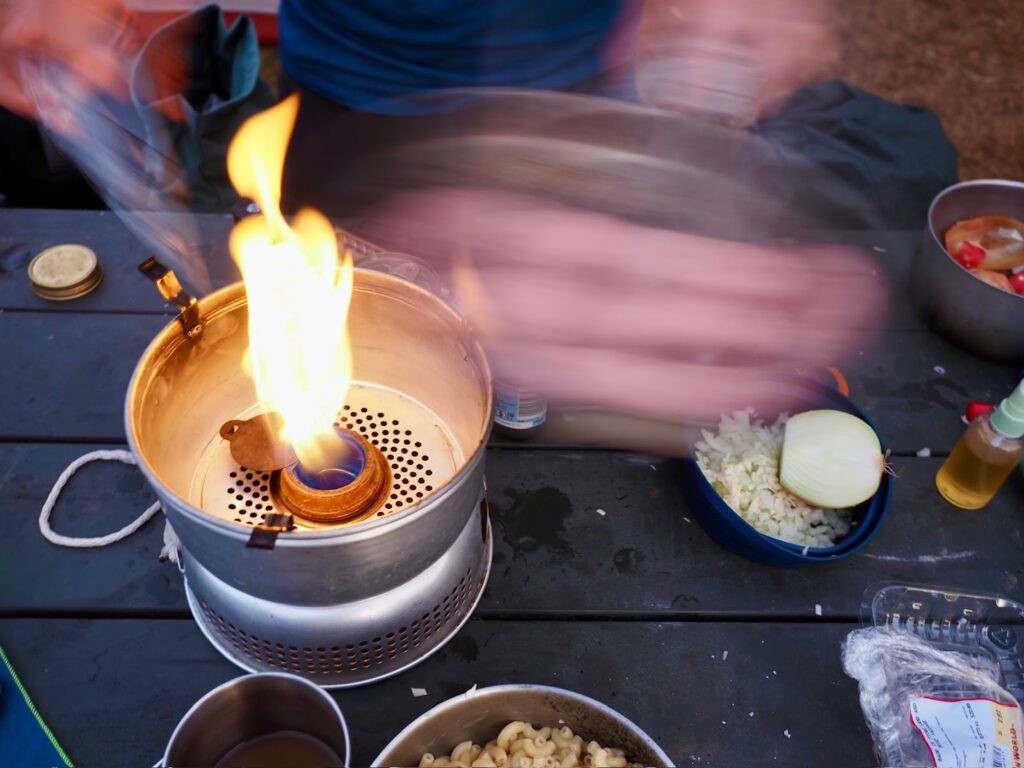
    When it came to cooking, we did our best to prepare most of our meals on our trusty Trangia camp stove. Unfortunately, in the backcountry, supermarkets were usually understocked and (even more) overpriced. Still, we made it work—though we definitely found ourselves dreaming of a well-stocked grocery store now and then! As for fuel, we used methylated spirits, which, thankfully, were easy to find throughout our trip.

    Route Planning & Navigation

    When we started our trip all we knew was that we wanted to get from Auckland to Christchurch – somehow! We had not planned out our route and were making it up day by day, which worked out just fine for us. For navigation we primarily used a big paper map and Komoot (a route planning app). There are not many roads in NZ so navigation could not have been more simple. It is almost impossible to get lost there.

    Truth be told, we ended up coinciding a lot with the TA (Tour Aotearoa) Route, especially on the South Island, so some more research into that could have probably been helpful for us, but we did not miss it.

    In NZ we eventually learnt that a minor road does not always equal a quiet road and a major road doesn’t always equal a busy road. That being said, if you can avoid the state highways (with exception of State Highway 6) you definitely should, especially on the North Island. 

    Our bike route on the North island of NZ
    Our cycling route on the North island of NZ.

    What would we do differently in hindsight? On the North Island we probably would have tried to stick to more Great Ride routes / TA Routes, as we had some less pleasant experiences on the Highways. You can read back on our North Island cycling highlights here.

    On the South Island we would repeat every single bit again (apart from the Maungatapu Saddle). The streets were overall quieter and the landscapes more majestic than anything we had seen up North. Here are more of our insights.

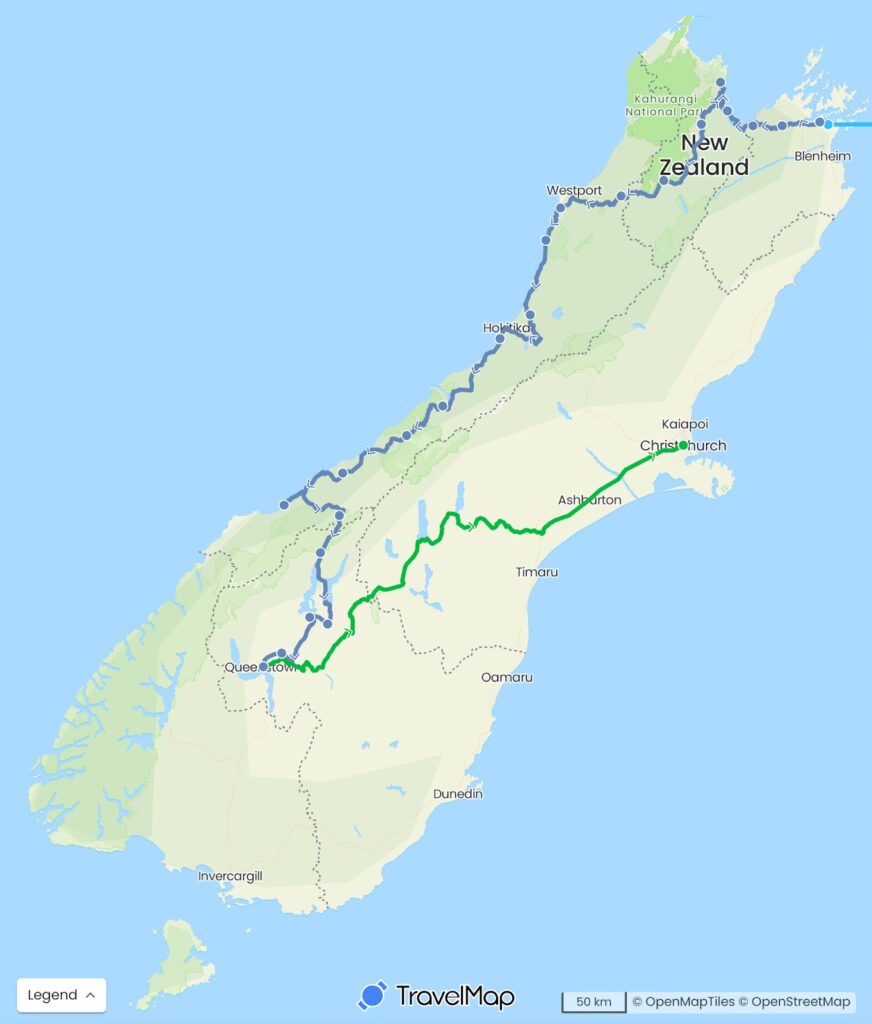
    Our bike route on the South island of NZ
    Our cycling route on the South Island of NZ.

    💡 Top Tip: We met a local tour guide before hitting the South Island, who gave us some wise advice for our route planning: “Go where the sun is”. The South Island is notorious for heavy, heavy rain and incredible downpours all year round. We were extremely lucky with our trip and the weather throughout, but we did witness the occasional turn of weather and it was a stark warning of what could have been. 

    ⚠️ Cycling Safety in NZ

    Road cycling in New Zealand can be challenging, especially outside the cities. Kiwis are generally not accustomed to seeing cyclists on the roads, and decent hard shoulders are often scarce. We noticed that many drivers didn’t seem to prioritize slowing down for cyclists or maintaining the recommended 1.5m distance when passing. Add to that the prevalence of large utility vehicles with trailers, and you’ll find yourself dodging some questionable overtaking maneuvers.

    If you’re planning to cycle in New Zealand, be prepared for frequent encounters with heavy-duty vehicles passing at high speeds. However, with the right precautions and gear, as well as avoiding the more busy State Highways, cycling can still be a highly enjoyable experience. And there are also many off-road options, which are totally manageable with a fully loaded tour bike.

    NZ road cycling must-haves: 

    • Rear view mirror 
    • High-Vis vest
    • Lights
    Rare sighting of the elusive ginger Kiwi bird.

    Final Thoughts

    Would we do it again? Absolutely! In fact, we felt there was still so much more to see that we’d go back in a heartbeat—whether to complete more of the Great Rides by bicycles or explore the many hiking trails we missed this time around.

    New Zealand is breathtaking in so many ways. Beyond its stunning landscapes, we were especially impressed by the efforts to protect native wildlife and preserve local ecosystems. It truly feels like an adventurous playground for outdoor lovers, with endless opportunities to explore.

    We hope to come back someday!

  • Cycling New Zealand: West Coast

    Cycling New Zealand: West Coast

    The Beauty, The Sandflies, The Rain

    The West Coast of the South Island is defined by three major factors: its natural beauty, its sandflies, and its inclement weather.

    Whenever we let the locals know that we were heading to the West Coast, they all repeated the same line: “The West Coast is beautiful, but bro, the sandflies are terrible, and the rain, it is wet as!” This was usually followed by a war story or two about a challenging time they had there. All the stories heavily featured aggressive biting sandflies and fat raindrops as their main characters.

    We had been enjoying an extended period of relaxed and leisurely riding as we ambled towards the West Coast on the South Island. In general, the roads on the South Island are much quieter than those on the North Island, and paradoxically, it also has flatter riding, despite having New Zealand’s largest mountain range, the Southern Alps, running along its spine. The North Island was much lumpier and congested by comparison.

    Our plan was very simple. We were going to follow State Highway 6 (SH6) for the next 700 km. We knew that there were some glaciers, a bike track (the Wilderness Trail), and some “Pancake Rocks” on the way. Of course, we also knew that there would be plenty of rain and sandflies to accompany us on our journey, but apart from that, we did not know much about what we would be doing or seeing along the way.

    Guided by the Buller River, we made our way into the heart of the West Coast. We swung south just before Westport and made camp at a secluded German pizzeria, where we washed, ate, drank, and rested. With our bellies full, we laughed at the good weather and the occasional sandfly that we gleefully squashed. “That’s one less,” we would think as we let out the type of laughter that you can only get from a day of exercise, sun, beer, and food. All our needs were met, and there was nothing left to do except laugh at how good life on the bike can be. The next morning we were slow to rise and lazily gathered up our things, then pedaled up a few hills (not quite laughing anymore, but nevertheless still smiling in the sun).

    Enjoying a German pizza and a Tui Beer at “Jack’s Gasthof”

    Although we had technically been on the West Coast for 100 or so kilometers, we had yet to see the coastline, the breathtaking beauty, the torrential rain, or the hordes of sandflies that we were repeatedly promised. That was soon to change. We caught a glimpse of a seagull or two, picked up the scent of seaweed and ocean spray, and then, as we turned the final corner of an ascent, we saw it. There it was, all laid out in front of us like an idyllic postcard or a Bob Ross painting brought to life. The beauty of the West Coast was there, bare-arsed and exposing itself to us. We stopped at the first viewpoint and gawked. This was the beauty they were talking about. After ogling it from our vantage point, we picked our jaws up from the floor and continued laughing. Only this time, we were laughing like deranged lunatics—the type of laughter reserved for the mentally unwell and for people who win the lotto.

    Our first look at the coastline

    We clambered back onto our bikes and continued laughing, heading due south. For now, the road hugged the coastline. We had the peaceful blue Tasman Sea on our right and the Paparoa National Park on our left. Life could not be better, but we were too busy enjoying ourselves to take any notice of that.

    We quickly arrived at the Pancake Rocks, an unusually rocky cliff formation that was formed over 30 million years from compacted marine sediments, uplifted by tectonic activity, and eroded by the sea. We sauntered up the short path from our campsite to the walkway that meandered through some native bush and led around the ridge of the cliffs, providing majestic views of the rocks that, as the name suggests, looked like layers of pancakes lazily stacked on top of each other. Words or photos cannot accurately do it justice; there is a majesty to the rocks that we cannot convey. They were truly awesome in the literal sense—they inspired awe. A must-do for anyone traveling the West Coast.

    The Pancake Rocks

    Next up was a much-needed resupply in Greymouth, one of the few towns with a real supermarket on the West Coast. It was both grey by name and gray by nature, so we quickly absconded and joined the Wilderness Trail, one of New Zealand’s “Great Rides.” The trail was well-marked and veered inland, away from the sea and quickly toward clear freshwater rivers, lakes, and dense rainforest. Yet again, we had exceptional riding on singletrack through spectacular forest dominated by ferns and birdsong. The shade of the trees and the abundance of fresh water made for easy and carefree travels as we made the most of our surroundings.

    Despite some rain during the night, the weather continued to hold, and the sandflies were yet to materialize. At this stage, we were starting to feel slightly suspicious, confused, and guilty. Did we really deserve to be this lucky??? We finished the trail in our usual leisurely fashion, still riding our luck as we joined back up with SH6 and continued due south. Give or take a forgotten helmet or two, we were making good progress down the SH6 and hurtling towards the glaciers. The two major glaciers were the Franz Josef and the Fox Glacier, both of which were only 25 km apart. At this stage, the large snow-capped peaks and the surreal aqua-colored rivers were the first clues that we were approaching the glaciers. The second clue was the abrasive shudder of helicopters offering tours of the glaciers and of Mount Cook (New Zealand’s highest mountain at 3,724m). The last and final clue was the obnoxious tourist traps and tacky gimmicks that had infested the towns at the base of the glaciers. It was all very contrived—the type of tourism optimized for extracting as much money as possible from the tour buses that rolled between there and the rest of the major tourist sites. We were quick to turn our noses up at their offerings and continued on without so much as a glance at the glaciers.

    We left the heights of the mountains and the blue skies behind us and continued south. We made camp near an impressive lake and got introduced to gangs of sandflies that we were warned about. However we were well-equipped to fight them. We covered ourselves from head to toe and spent an afternoon at a campsite catching up with some general admin and maintenance jobs that we had been neglecting. Despite our best efforts to fend off the sandflies, some of the more ambitious ones still managed to find gaps in our armor. Watching some of our fellow campers dressed in shorts and sandals, struggle and scratch brought a sinister smile back to our faces. We sniggered at the others as we hid behind our high walls of gloves, head nets, hats, jackets, and pants tucked into socks,

    The next day, we mounted our high horses and headed to Haast (a World Heritage Area), where we had an Airbnb booked to rest up and shelter from the forecasted 100% chance of rain. We were lucky enough to get a rain-free glimpse of the beach before the really heavy downpours started. At the time of writing, we are tucked away in a small house near Jackson Bay. The wind and rain that we were promised has been pelting the windows all day, but the endless cups of tea are keeping us warm and cozy.

    Jackson Bay (Haast)

    We are readying ourselves for the Haast Pass and the onward journey to the next major town of Wānaka. While the forecast is promising, we know that Haast Pass is notorious for rapid weather changes. For now, all we can do is wash our clothes, charge our electronics, catch up with our admin tasks, rest, and nervously laugh at how we are not cycling in this dreadful weather.

  • Cycling New Zealand: The North Island

    Cycling New Zealand: The North Island

    As we write this blog entry for you, we are sitting on the ferry from Wellington to Picton, which means that we have concluded the first part of our New Zealand travels on the North Island—a small but significant milestone in our ambitious journey ahead. While the ferry carries us across Cook Strait, we reflect on the past weeks and our impressions of New Zealand’s northern island so far.

    Our route (which, by the way, you can always follow/retrace here) was planned on the go. We had a loose idea of where we wanted to go, but we wanted to leave space for recommendations and spontaneity. We started our journey up north in Auckland City, and although our legs were untrained, we took on the lumpy Coromandel Peninsula first. After a slow first week, we made our way down to Rotorua (or RottenEggsRua—the place stinks of sulfur from all the surfacing hot springs and volcanic activity). We weren’t overly impressed with Rotorua itself – perhaps it was the overpowering sulfuric smell –  but we did enjoy riding out through the Whakarewarewa Forest. We then had to decide whether to conquer Lake Taupo’s east or west side—well, we went for the “Wild West,” and many hills later, we had made it south of the lake, arriving in Turangi.

    After a much-needed rest day, we were ready to ‘simply cycle into Mordor,’ otherwise known as Tongariro National Park. Rain and clouds accompanied us throughout this two-day endeavor, unfortunately allowing only scarce views of the three active volcanoes situated here (including ‘Mount Doom’). We were then spit out onto a terrible stretch of state highway and were eager to get off it as soon as possible. Our aim was the peaceful counterpart, Whanganui River Road, which we followed all the way back to the coast. At the end of it, black sand beaches filled with dramatically contrasting driftwood gave us a beautiful reunion with the ocean after two weeks of inland cycling.

    A happy Conor running into the Tasman Sea.

    At this stage, we were becoming more and more eager to see the South Island—widely praised by many Kiwis, travelers, and friends for its dramatic landscapes and breathtaking cycling routes. It felt like everything was building up to the epic southern landscapes. So, with nothing left holding us up north, we decided to hightail it to Wellington but were pleasantly surprised along the way. We discovered magnificent roads for cycling, including a decommissioned section of State Highway 3, and enjoyed our remaining North Island days more than expected. The final push to Wellington was not done by our own legs; instead, we took a train from Masterton to avoid traffic and big roads entering the city.

    We were told many times not to waste too much time up north, and it is true that many hours of our cycling were spent beside fenced-off fields, either empty or full of sheep and cattle. We also endured some hours on busy roads with heavy traffic, trucks, and pickup vans—not great. But overall, the North Island treated us well, and we had a blast. In terms of cycling, we experienced some real highlights that we want to share with you:

    1. Whakarewarewa Forest

    We decided to skip the more direct and boring highway exit out of Rotorua. Instead, we ventured out to do part of the Whakarewarewa Loop, one of New Zealand’s Great Rides. It took us through giant Californian redwoods first, and while they were big and impressive, they didn’t quite live up to our equally large expectations. The loop then took us to the picturesque Blue Lake (Lake Tikitapu), a good spot for a dip and some pies.

    It was at this point that the trail disappeared into a thick wall of trees. Picture us—overloaded gravel bikes, fully equipped with panniers, front fork bags, handlebar bags… Naturally, we were somewhat nervous about taking an off-road loop through a native forest. Well, we were in for a treat. Not only did our bikes love it, but we were in awe—a beautiful track undulating its way up and down through a tunnel of ferns, trees, birdsong, and pure green. Tumbling through the trees and emerging on the other side was amazing fun.

    Whakarewarewa Forest Loop
    1. Whanganui River Road

    Our second highlight was the Whanganui River Road, another one of New Zealand’s Great Rides called Mountains to Sea. The area is steeped in both Māori and European history, full of natural wilderness and heritage. The lush greenery sprouting from either side of the riverbed is a well-protected haven for birds and native bush alike. We joined the river road for its final 70 km, where it drains into the Tasman Sea.

    The route took us through a stunning stretch of land. At times, the hills were testing, and the weather didn’t always cooperate, but the birds sang loud and proud, cheering us on as we climbed through this amazing patch of paradise. With the river as our only constant companion, it really felt like we were the only ones there—a welcome contrast to the previous day, when we had battled our way down a congested stretch of state highway.

    1. The (Old) State Highway 3

    Last but not least, the biggest surprise for us was the old State Highway 3 cutting through the Manawatũ Gorge. We had no idea what we were getting into when we found ourselves pushing our bicycles through a construction site, then down a single track, and eventually through holes in broken fences. At first, we were cursing Google Maps for taking us (once again) down a sketchy path, possibly leading to an impassable road. Instead, we were presented with the most eerily beautiful road—a once-busy highway passing through a small mountain range.

    The road was closed eight years ago due to major landslides (“slips”), and while we weren’t sure if it was fully passable, locals reassured us that it was an adventurous but feasible route. Now defunct, it is commonly used by locals for walking, running, and cycling (several locals assured us beforehand that it was a feasible route). Nature has since reclaimed this once-main highway, and in many places, the overgrown road looks almost like a scene from a post-apocalyptic movie. The novelty of cycling down this abandoned highway never wore off. Having the time and space to take it all in was fantastic and left us wondering, “Why aren’t all roads abandoned like this?” Thankfully, even after exiting this approximately 15 km stretch of bliss, we were gifted with amazing roads with hardly any traffic all the way to Masterton.

    Alina hauling her bicycle into the closed off road.

    We’re off to the South Island now and will update you soon on how we’re getting on! 👀

    Happy cycling!

    PS: Roads We Would NOT Recommend

    If you happen to be cycling through the North Island of New Zealand, here are some roads we’d avoid due to safety concerns and heavy traffic:

    🚫 State Highway 25A (connecting Hikuai with Kopu, in the southern part of the Coromandel Peninsula): A nightmare—barely any hard shoulder and many trucks and pickup vans.  

    🚫 State Highway 4 (connecting National Park with Raetihi).  

    In general, try to avoid the major state highways that serve as primary connectors between big cities. Due to road closures, for us some routes were more congested than usual, making certain sections even less enjoyable for cycling.

  • The Story of (Re-)Creation: Alina & Conor on Bicycles

    The Story of (Re-)Creation: Alina & Conor on Bicycles

    Day 1: Let There Be Bikes  

    And so it was that Alina and Conor emerged from the great city of Auckland, where the sprawl is vast and the roads are treacherous. They boarded the mighty train, which carried them forth beyond the lands of chaos, delivering them to the promised realm of Takaanini (South Auckland). Here, they set their feet upon their steel steeds, and the journey began.

    The path was paved with good intentions and also with large, swift pick-up trucks. For though they sought the small roads, the roaring machines of Auckland followed them yet. But lo, the further they traveled, the quieter the roads became, until at last they reached a sacred place—a tranquil beach, nestled by the regional park Tapapakanga. It was here that they rested, bathing in the Pacific, meeting the wise and well-traveled Alice, who planned to cycle the long path from Singapore to France. Humbled, they lay down their weary bodies and prepared for the trials ahead.

    Setting up camp at the end of day 1

    Day 2: The Fall of Woman  

    Morning came, and with it, the realization that their food supplies were as empty as their energy reserves. They rode forth to the Coromandel, where the people, ever wise and ever chatty, warned them of the treacheries of State Highway 25.

    Seeking an alternative path, they found it closed. And in that moment of dismay, Alina did stumble—not upon rocks or obstacles, but upon herself, toppling to the ground in an act of divine comedy, unable to remove her feet from the steel steeds. She arose, bruised but unbowed, and they pressed on to Thames. The road was long, the effort great, and by the time they arrived, their spirits were as depleted as their legs. They sought refuge in a campsite, collapsed, and decreed that on the morrow, there would be no pedaling. And it was good.

    Day 3: And on the Third Day, They Rested  

    There was no walking, no riding, and certainly no climbing of unnecessary hills. Instead, there was a river, there was food, and there was an abundance of fish—bestowed upon them by a generous stranger who had simply caught too many. Thus, they feasted and were content.

    Day 4: The Trials of the Mountain

    With renewed vigor, they faced the feared State Highway 25, where the narrow ways and hasty drivers loomed large. But behold, the warnings of the elders had been slightly exaggerated! For though the road was perilous, the views were mighty, and the coastline stretched before them in divine splendor.

    But then came the great mountain. As they ascended, the road grew steep, and Alina’s strength waned. Every 200 meters, she paused, feeding her body sugar as though it were the manna of the weary. Conor, patient as can be, bestowed in her confidence and hope. And finally, after much suffering, they reached the summit, where the land spread before them in glorious beauty. Yet, their trials were not over, for their chosen campsite had ceased to exist.

    A wandering sage appeared—a man on his evening walk—who guided them to a benevolent host named Earl. And Earl, in his wisdom, allowed them sanctuary upon his land. And there was much rejoicing.

    Day 5: The Temptation of the Beach

    The morning was one of indecision. For in the land of Whangapoua lay a fabled beach, one of the finest in the world according to the all knowing Lonely Planet, yet since plagued by the multitudes of visitors. To go or not to go? But the path was set before them, and Earl himself delivered them unto the trailhead. And there, beyond the crowded first 200 meters, lay paradise. The multitudes were unable to see beyond their own feet, and much to the joy of Conor and Alina a majestic beach revealed itself. 

    Location New Chums Beach

    They swam, they played, and then they departed, for the great Coroglen Tavern awaited. Yet the journey was not without suffering, for also Conor had lost his nimbleness and stumbled upon himself in the safety of a static stance. As for Alina, her back began to ache, a reminder of their mortal fragility. But they pressed on, and in the hallowed halls of the Tavern, they found not only beer but also camaraderie in the form of Vicky and Owen, with whom they shared an evening of revelry. And thus, their cups overflowed, and it was very good.

    Day 6: The Morning After  

    The sun rose, but Alina and Conor did not. At least, not quickly. The revelry of the previous night had left them slow and ponderous. But the road called, and they answered, cycling onward to Tairaru, where they broke bread by the sea.

    And as the day waned, they journeyed into the wilderness, where a hidden campsite, nestled among the native bush, awaited them. The cicadas sang their songs of welcome, and the land was still. Thus, they slept, weary but victorious.

    What began as a peaceful day soon turned to madness. A rustic path led them onward, but it was no path at all—it was a river. With great effort, they carried their bags and bicycles, wading through the waters like pilgrims seeking dry land. And when at last they reached the road, they thought their trials were over. But lo, the dreaded State Highway 25A awaited.

    The trail that suddenly turned into a stream

    The trucks were relentless, the shoulders of the road nonexistent, and the climb unending. Sweat poured, curses were uttered, and when at last they reached the top, there was no view to reward their suffering, a true test of their faith. But then, the descent came, and with it, relief.

    The road changed, the land flattened, and cow pastures stretched as far as the eye could see. And though the rain came, they rode on, until at last they arrived at a place of rest—a humble tavern where Guinness flowed, and an orchard of plenty awaited with space for their nightly rest. And thus, they feasted upon apples, pears, and plums, and all was well.

    And so, it was written: the first week was completed, and though there was suffering, there was also triumph. And thus, Alina and Conor cycled forth, into the unknown.

    THE END