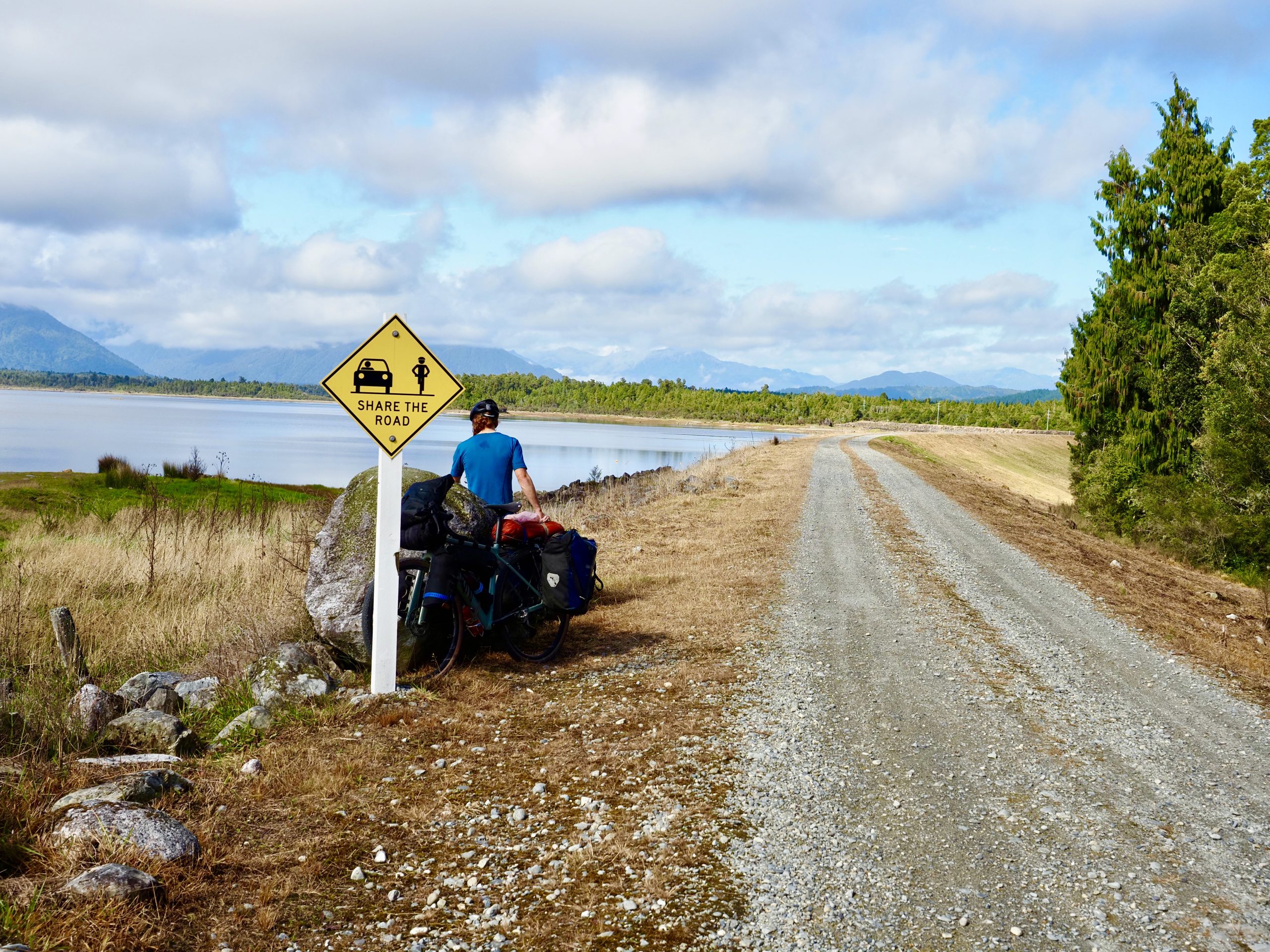
Author: Conor and Alina

  • Cycling New Zealand: West Coast

    Cycling New Zealand: West Coast

    The Beauty, The Sandflies, The Rain

    The West Coast of the South Island is defined by three major factors: its natural beauty, its sandflies, and its inclement weather.

    Whenever we let the locals know that we were heading to the West Coast, they all repeated the same line: “The West Coast is beautiful, but bro, the sandflies are terrible, and the rain, it is wet as!” This was usually followed by a war story or two about a challenging time they had there. All the stories heavily featured aggressive biting sandflies and fat raindrops as their main characters.

    We had been enjoying an extended period of relaxed and leisurely riding as we ambled towards the West Coast on the South Island. In general, the roads on the South Island are much quieter than those on the North Island, and paradoxically, it also has flatter riding, despite having New Zealand’s largest mountain range, the Southern Alps, running along its spine. The North Island was much lumpier and congested by comparison.

    Our plan was very simple. We were going to follow State Highway 6 (SH6) for the next 700 km. We knew that there were some glaciers, a bike track (the Wilderness Trail), and some “Pancake Rocks” on the way. Of course, we also knew that there would be plenty of rain and sandflies to accompany us on our journey, but apart from that, we did not know much about what we would be doing or seeing along the way.

    Guided by the Buller River, we made our way into the heart of the West Coast. We swung south just before Westport and made camp at a secluded German pizzeria, where we washed, ate, drank, and rested. With our bellies full, we laughed at the good weather and the occasional sandfly that we gleefully squashed. “That’s one less,” we would think as we let out the type of laughter that you can only get from a day of exercise, sun, beer, and food. All our needs were met, and there was nothing left to do except laugh at how good life on the bike can be. The next morning we were slow to rise and lazily gathered up our things, then pedaled up a few hills (not quite laughing anymore, but nevertheless still smiling in the sun).

    Enjoying a German pizza and a Tui Beer at “Jack’s Gasthof”

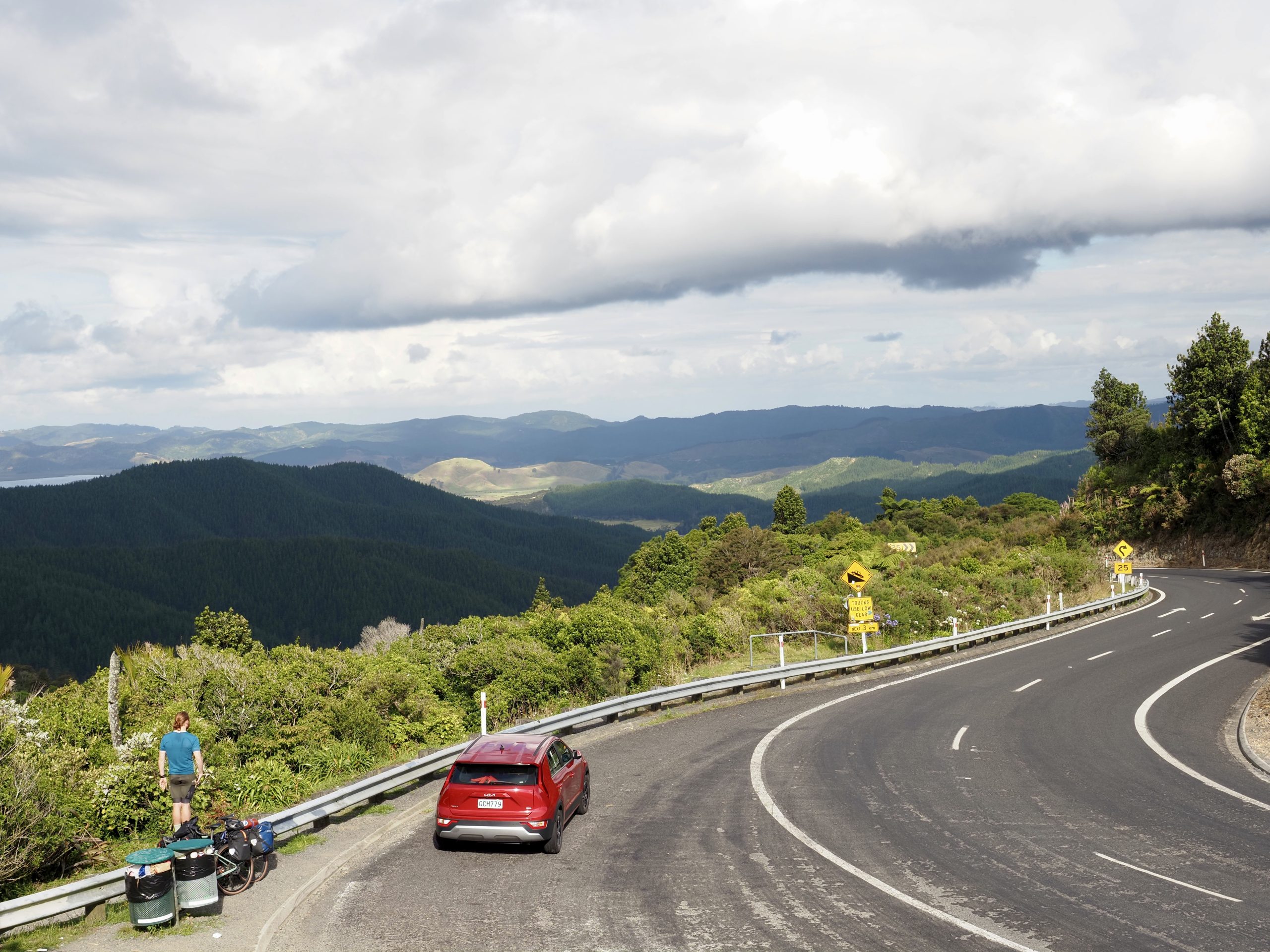
    Although we had technically been on the West Coast for 100 or so kilometers, we had yet to see the coastline, the breathtaking beauty, the torrential rain, or the hordes of sandflies that we were repeatedly promised. That was soon to change. We caught a glimpse of a seagull or two, picked up the scent of seaweed and ocean spray, and then, as we turned the final corner of an ascent, we saw it. There it was, all laid out in front of us like an idyllic postcard or a Bob Ross painting brought to life. The beauty of the West Coast was there, bare-arsed and exposing itself to us. We stopped at the first viewpoint and gawked. This was the beauty they were talking about. After ogling it from our vantage point, we picked our jaws up from the floor and continued laughing. Only this time, we were laughing like deranged lunatics—the type of laughter reserved for the mentally unwell and for people who win the lotto.

    Our first look at the coastline

    We clambered back onto our bikes and continued laughing, heading due south. For now, the road hugged the coastline. We had the peaceful blue Tasman Sea on our right and the Paparoa National Park on our left. Life could not be better, but we were too busy enjoying ourselves to take any notice of that.

    We quickly arrived at the Pancake Rocks, an unusually rocky cliff formation that was formed over 30 million years from compacted marine sediments, uplifted by tectonic activity, and eroded by the sea. We sauntered up the short path from our campsite to the walkway that meandered through some native bush and led around the ridge of the cliffs, providing majestic views of the rocks that, as the name suggests, looked like layers of pancakes lazily stacked on top of each other. Words or photos cannot accurately do it justice; there is a majesty to the rocks that we cannot convey. They were truly awesome in the literal sense—they inspired awe. A must-do for anyone traveling the West Coast.

    The Pancake Rocks

    Next up was a much-needed resupply in Greymouth, one of the few towns with a real supermarket on the West Coast. It was both grey by name and gray by nature, so we quickly absconded and joined the Wilderness Trail, one of New Zealand’s “Great Rides.” The trail was well-marked and veered inland, away from the sea and quickly toward clear freshwater rivers, lakes, and dense rainforest. Yet again, we had exceptional riding on singletrack through spectacular forest dominated by ferns and birdsong. The shade of the trees and the abundance of fresh water made for easy and carefree travels as we made the most of our surroundings.

    Despite some rain during the night, the weather continued to hold, and the sandflies were yet to materialize. At this stage, we were starting to feel slightly suspicious, confused, and guilty. Did we really deserve to be this lucky??? We finished the trail in our usual leisurely fashion, still riding our luck as we joined back up with SH6 and continued due south. Give or take a forgotten helmet or two, we were making good progress down the SH6 and hurtling towards the glaciers. The two major glaciers were the Franz Josef and the Fox Glacier, both of which were only 25 km apart. At this stage, the large snow-capped peaks and the surreal aqua-colored rivers were the first clues that we were approaching the glaciers. The second clue was the abrasive shudder of helicopters offering tours of the glaciers and of Mount Cook (New Zealand’s highest mountain at 3,724m). The last and final clue was the obnoxious tourist traps and tacky gimmicks that had infested the towns at the base of the glaciers. It was all very contrived—the type of tourism optimized for extracting as much money as possible from the tour buses that rolled between there and the rest of the major tourist sites. We were quick to turn our noses up at their offerings and continued on without so much as a glance at the glaciers.

    We left the heights of the mountains and the blue skies behind us and continued south. We made camp near an impressive lake and got introduced to gangs of sandflies that we were warned about. However we were well-equipped to fight them. We covered ourselves from head to toe and spent an afternoon at a campsite catching up with some general admin and maintenance jobs that we had been neglecting. Despite our best efforts to fend off the sandflies, some of the more ambitious ones still managed to find gaps in our armor. Watching some of our fellow campers dressed in shorts and sandals, struggle and scratch brought a sinister smile back to our faces. We sniggered at the others as we hid behind our high walls of gloves, head nets, hats, jackets, and pants tucked into socks,

    The next day, we mounted our high horses and headed to Haast (a World Heritage Area), where we had an Airbnb booked to rest up and shelter from the forecasted 100% chance of rain. We were lucky enough to get a rain-free glimpse of the beach before the really heavy downpours started. At the time of writing, we are tucked away in a small house near Jackson Bay. The wind and rain that we were promised has been pelting the windows all day, but the endless cups of tea are keeping us warm and cozy.

    Jackson Bay (Haast)

    We are readying ourselves for the Haast Pass and the onward journey to the next major town of Wānaka. While the forecast is promising, we know that Haast Pass is notorious for rapid weather changes. For now, all we can do is wash our clothes, charge our electronics, catch up with our admin tasks, rest, and nervously laugh at how we are not cycling in this dreadful weather.
  • Cycling New Zealand: The North Island

    Cycling New Zealand: The North Island

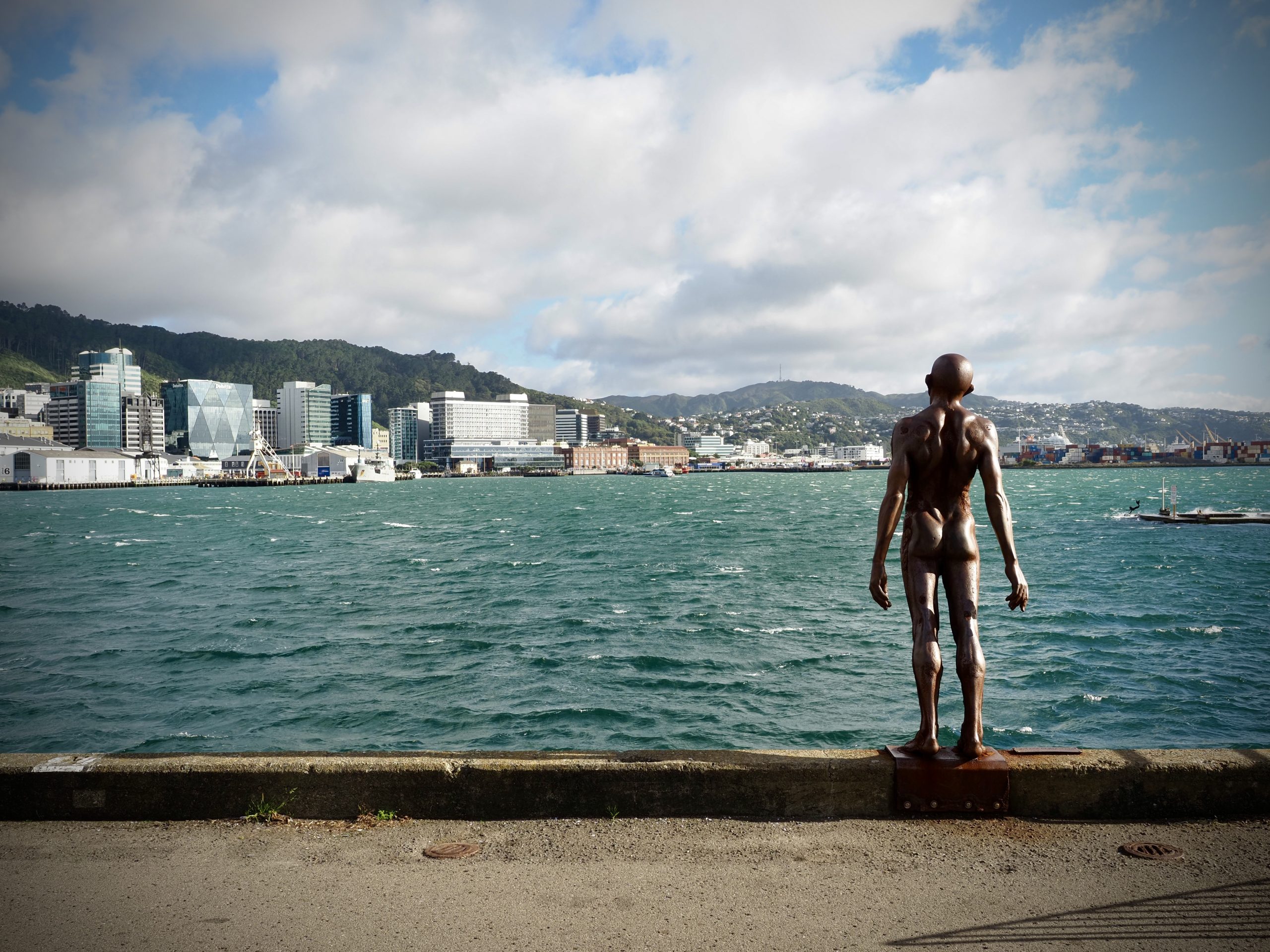
    As we write this blog entry for you, we are sitting on the ferry from Wellington to Picton, which means that we have concluded the first part of our New Zealand travels on the North Island—a small but significant milestone in our ambitious journey ahead. While the ferry carries us across Cook Strait, we reflect on the past weeks and our impressions of New Zealand’s northern island so far.

    Our route (which, by the way, you can always follow/retrace here) was planned on the go. We had a loose idea of where we wanted to go, but we wanted to leave space for recommendations and spontaneity. We started our journey up north in Auckland City, and although our legs were untrained, we took on the lumpy Coromandel Peninsula first. After a slow first week, we made our way down to Rotorua (or RottenEggsRua—the place stinks of sulfur from all the surfacing hot springs and volcanic activity). We weren’t overly impressed with Rotorua itself – perhaps it was the overpowering sulfuric smell –  but we did enjoy riding out through the Whakarewarewa Forest. We then had to decide whether to conquer Lake Taupo’s east or west side—well, we went for the “Wild West,” and many hills later, we had made it south of the lake, arriving in Turangi.

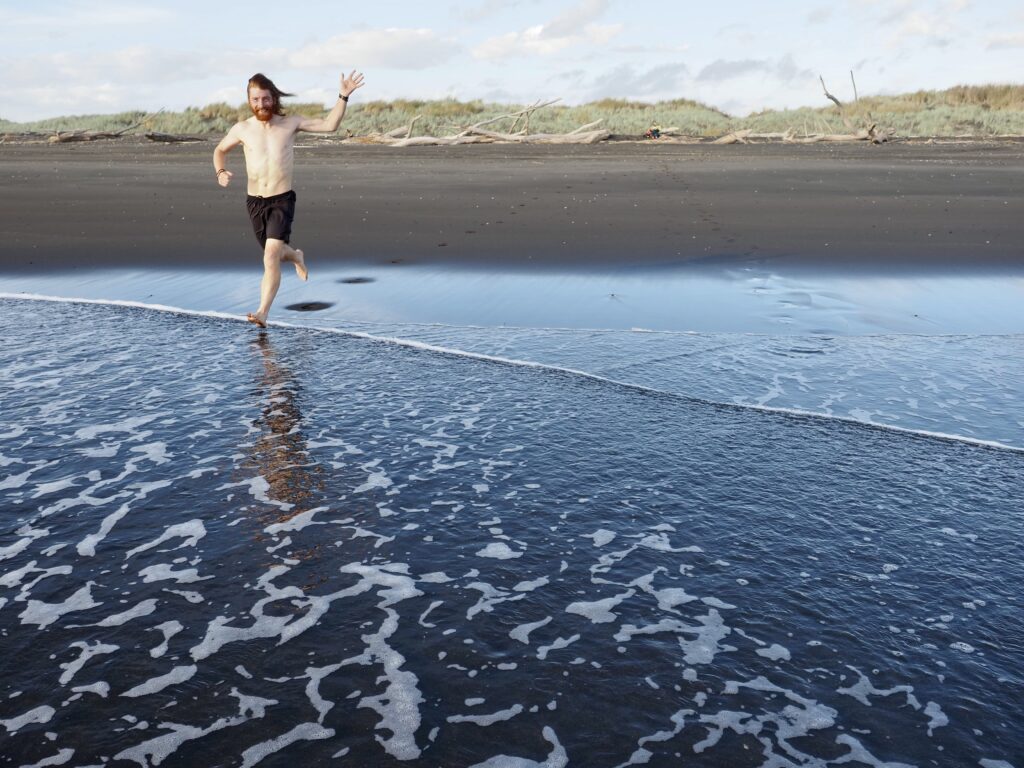
    After a much-needed rest day, we were ready to ‘simply cycle into Mordor,’ otherwise known as Tongariro National Park. Rain and clouds accompanied us throughout this two-day endeavor, unfortunately allowing only scarce views of the three active volcanoes situated here (including ‘Mount Doom’). We were then spit out onto a terrible stretch of state highway and were eager to get off it as soon as possible. Our aim was the peaceful counterpart, Whanganui River Road, which we followed all the way back to the coast. At the end of it, black sand beaches filled with dramatically contrasting driftwood gave us a beautiful reunion with the ocean after two weeks of inland cycling.

    A happy Conor running into the Tasman Sea.

    At this stage, we were becoming more and more eager to see the South Island—widely praised by many Kiwis, travelers, and friends for its dramatic landscapes and breathtaking cycling routes. It felt like everything was building up to the epic southern landscapes. So, with nothing left holding us up north, we decided to hightail it to Wellington but were pleasantly surprised along the way. We discovered magnificent roads for cycling, including a decommissioned section of State Highway 3, and enjoyed our remaining North Island days more than expected. The final push to Wellington was not done by our own legs; instead, we took a train from Masterton to avoid traffic and big roads entering the city.

    We were told many times not to waste too much time up north, and it is true that many hours of our cycling were spent beside fenced-off fields, either empty or full of sheep and cattle. We also endured some hours on busy roads with heavy traffic, trucks, and pickup vans—not great. But overall, the North Island treated us well, and we had a blast. In terms of cycling, we experienced some real highlights that we want to share with you:

    1. Whakarewarewa Forest

    We decided to skip the more direct and boring highway exit out of Rotorua. Instead, we ventured out to do part of the Whakarewarewa Loop, one of New Zealand’s Great Rides. It took us through giant Californian redwoods first, and while they were big and impressive, they didn’t quite live up to our equally large expectations. The loop then took us to the picturesque Blue Lake (Lake Tikitapu), a good spot for a dip and some pies.

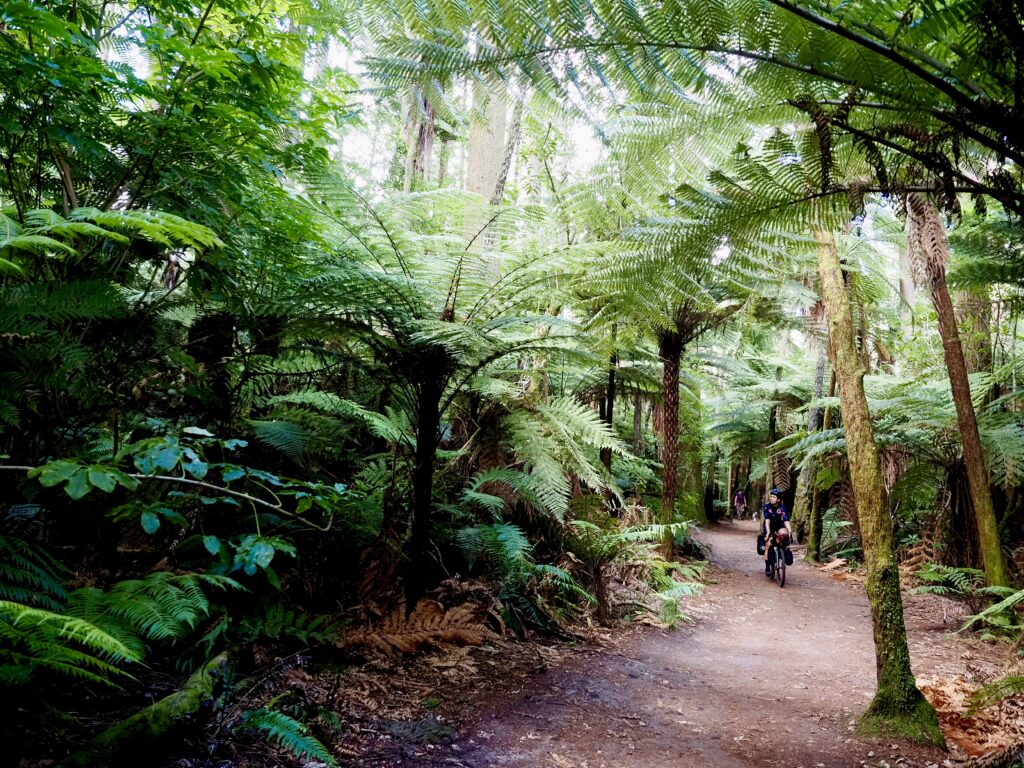
    It was at this point that the trail disappeared into a thick wall of trees. Picture us—overloaded gravel bikes, fully equipped with panniers, front fork bags, handlebar bags… Naturally, we were somewhat nervous about taking an off-road loop through a native forest. Well, we were in for a treat. Not only did our bikes love it, but we were in awe—a beautiful track undulating its way up and down through a tunnel of ferns, trees, birdsong, and pure green. Tumbling through the trees and emerging on the other side was amazing fun.

    Whakarewarewa Forest Loop
    1. Whanganui River Road

    Our second highlight was the Whanganui River Road, another one of New Zealand’s Great Rides called Mountains to Sea. The area is steeped in both Māori and European history, full of natural wilderness and heritage. The lush greenery sprouting from either side of the riverbed is a well-protected haven for birds and native bush alike. We joined the river road for its final 70 km, where it drains into the Tasman Sea.

    The route took us through a stunning stretch of land. At times, the hills were testing, and the weather didn’t always cooperate, but the birds sang loud and proud, cheering us on as we climbed through this amazing patch of paradise. With the river as our only constant companion, it really felt like we were the only ones there—a welcome contrast to the previous day, when we had battled our way down a congested stretch of state highway.

    1. The (Old) State Highway 3

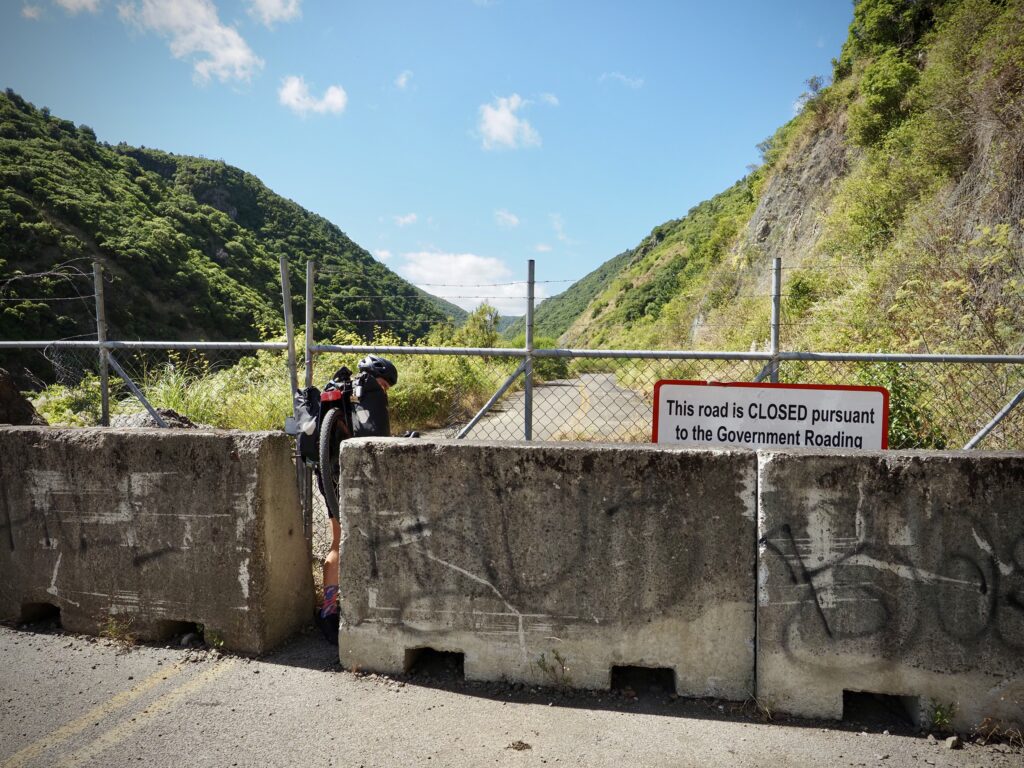
    Last but not least, the biggest surprise for us was the old State Highway 3 cutting through the Manawatũ Gorge. We had no idea what we were getting into when we found ourselves pushing our bicycles through a construction site, then down a single track, and eventually through holes in broken fences. At first, we were cursing Google Maps for taking us (once again) down a sketchy path, possibly leading to an impassable road. Instead, we were presented with the most eerily beautiful road—a once-busy highway passing through a small mountain range.

    The road was closed eight years ago due to major landslides (“slips”), and while we weren’t sure if it was fully passable, locals reassured us that it was an adventurous but feasible route. Now defunct, it is commonly used by locals for walking, running, and cycling (several locals assured us beforehand that it was a feasible route). Nature has since reclaimed this once-main highway, and in many places, the overgrown road looks almost like a scene from a post-apocalyptic movie. The novelty of cycling down this abandoned highway never wore off. Having the time and space to take it all in was fantastic and left us wondering, “Why aren’t all roads abandoned like this?” Thankfully, even after exiting this approximately 15 km stretch of bliss, we were gifted with amazing roads with hardly any traffic all the way to Masterton.

    Alina hauling her bicycle into the closed off road.

    We’re off to the South Island now and will update you soon on how we’re getting on! 👀

    Happy cycling!

    PS: Roads We Would NOT Recommend

    If you happen to be cycling through the North Island of New Zealand, here are some roads we’d avoid due to safety concerns and heavy traffic:

    🚫 State Highway 25A (connecting Hikuai with Kopu, in the southern part of the Coromandel Peninsula): A nightmare—barely any hard shoulder and many trucks and pickup vans.  

    🚫 State Highway 4 (connecting National Park with Raetihi).  

    In general, try to avoid the major state highways that serve as primary connectors between big cities. Due to road closures, for us some routes were more congested than usual, making certain sections even less enjoyable for cycling.

  • The Story of (Re-)Creation: Alina & Conor on Bicycles

    The Story of (Re-)Creation: Alina & Conor on Bicycles

    Day 1: Let There Be Bikes  

    And so it was that Alina and Conor emerged from the great city of Auckland, where the sprawl is vast and the roads are treacherous. They boarded the mighty train, which carried them forth beyond the lands of chaos, delivering them to the promised realm of Takaanini (South Auckland). Here, they set their feet upon their steel steeds, and the journey began.

    The path was paved with good intentions and also with large, swift pick-up trucks. For though they sought the small roads, the roaring machines of Auckland followed them yet. But lo, the further they traveled, the quieter the roads became, until at last they reached a sacred place—a tranquil beach, nestled by the regional park Tapapakanga. It was here that they rested, bathing in the Pacific, meeting the wise and well-traveled Alice, who planned to cycle the long path from Singapore to France. Humbled, they lay down their weary bodies and prepared for the trials ahead.

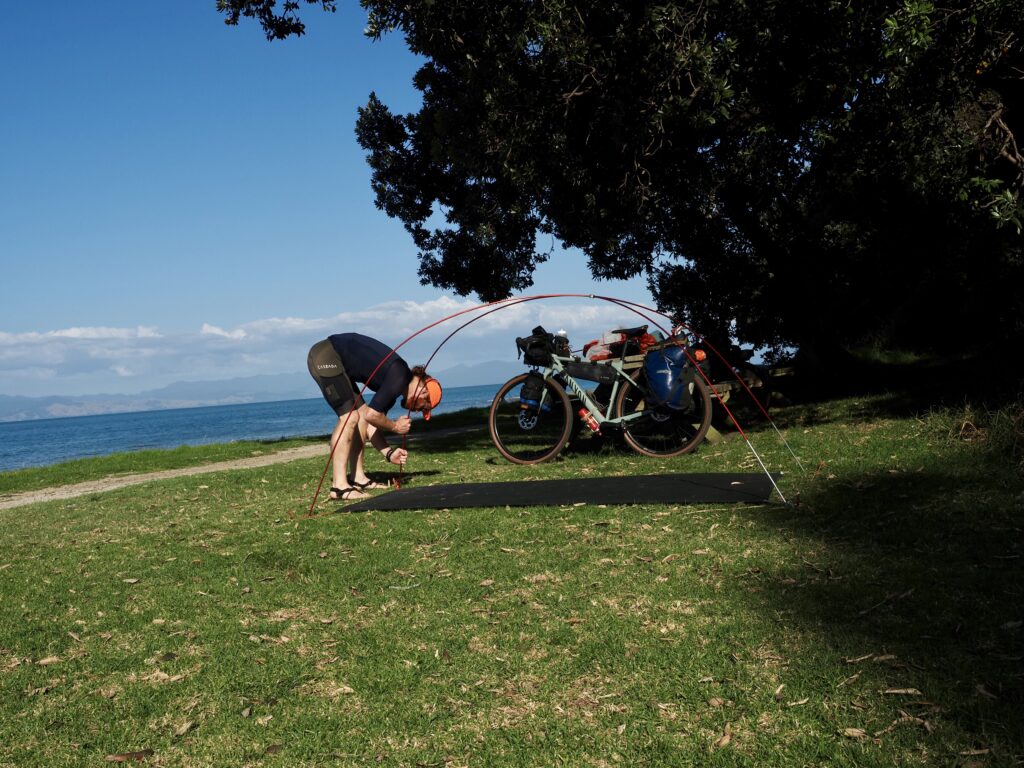
    Setting up camp at the end of day 1

    Day 2: The Fall of Woman  

    Morning came, and with it, the realization that their food supplies were as empty as their energy reserves. They rode forth to the Coromandel, where the people, ever wise and ever chatty, warned them of the treacheries of State Highway 25.

    Seeking an alternative path, they found it closed. And in that moment of dismay, Alina did stumble—not upon rocks or obstacles, but upon herself, toppling to the ground in an act of divine comedy, unable to remove her feet from the steel steeds. She arose, bruised but unbowed, and they pressed on to Thames. The road was long, the effort great, and by the time they arrived, their spirits were as depleted as their legs. They sought refuge in a campsite, collapsed, and decreed that on the morrow, there would be no pedaling. And it was good.

    Day 3: And on the Third Day, They Rested  

    There was no walking, no riding, and certainly no climbing of unnecessary hills. Instead, there was a river, there was food, and there was an abundance of fish—bestowed upon them by a generous stranger who had simply caught too many. Thus, they feasted and were content.

    Day 4: The Trials of the Mountain

    With renewed vigor, they faced the feared State Highway 25, where the narrow ways and hasty drivers loomed large. But behold, the warnings of the elders had been slightly exaggerated! For though the road was perilous, the views were mighty, and the coastline stretched before them in divine splendor.

    But then came the great mountain. As they ascended, the road grew steep, and Alina’s strength waned. Every 200 meters, she paused, feeding her body sugar as though it were the manna of the weary. Conor, patient as can be, bestowed in her confidence and hope. And finally, after much suffering, they reached the summit, where the land spread before them in glorious beauty. Yet, their trials were not over, for their chosen campsite had ceased to exist.

    A wandering sage appeared—a man on his evening walk—who guided them to a benevolent host named Earl. And Earl, in his wisdom, allowed them sanctuary upon his land. And there was much rejoicing.

    Day 5: The Temptation of the Beach

    The morning was one of indecision. For in the land of Whangapoua lay a fabled beach, one of the finest in the world according to the all knowing Lonely Planet, yet since plagued by the multitudes of visitors. To go or not to go? But the path was set before them, and Earl himself delivered them unto the trailhead. And there, beyond the crowded first 200 meters, lay paradise. The multitudes were unable to see beyond their own feet, and much to the joy of Conor and Alina a majestic beach revealed itself. 

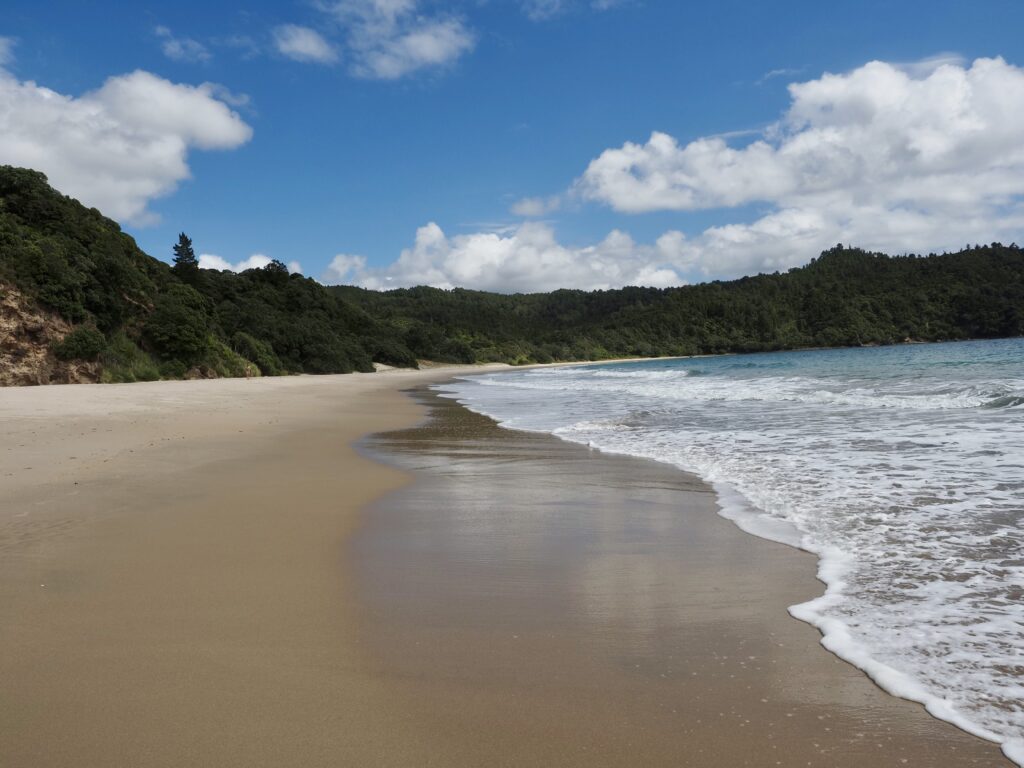
    Location New Chums Beach

    They swam, they played, and then they departed, for the great Coroglen Tavern awaited. Yet the journey was not without suffering, for also Conor had lost his nimbleness and stumbled upon himself in the safety of a static stance. As for Alina, her back began to ache, a reminder of their mortal fragility. But they pressed on, and in the hallowed halls of the Tavern, they found not only beer but also camaraderie in the form of Vicky and Owen, with whom they shared an evening of revelry. And thus, their cups overflowed, and it was very good.

    Day 6: The Morning After  

    The sun rose, but Alina and Conor did not. At least, not quickly. The revelry of the previous night had left them slow and ponderous. But the road called, and they answered, cycling onward to Tairaru, where they broke bread by the sea.

    And as the day waned, they journeyed into the wilderness, where a hidden campsite, nestled among the native bush, awaited them. The cicadas sang their songs of welcome, and the land was still. Thus, they slept, weary but victorious.

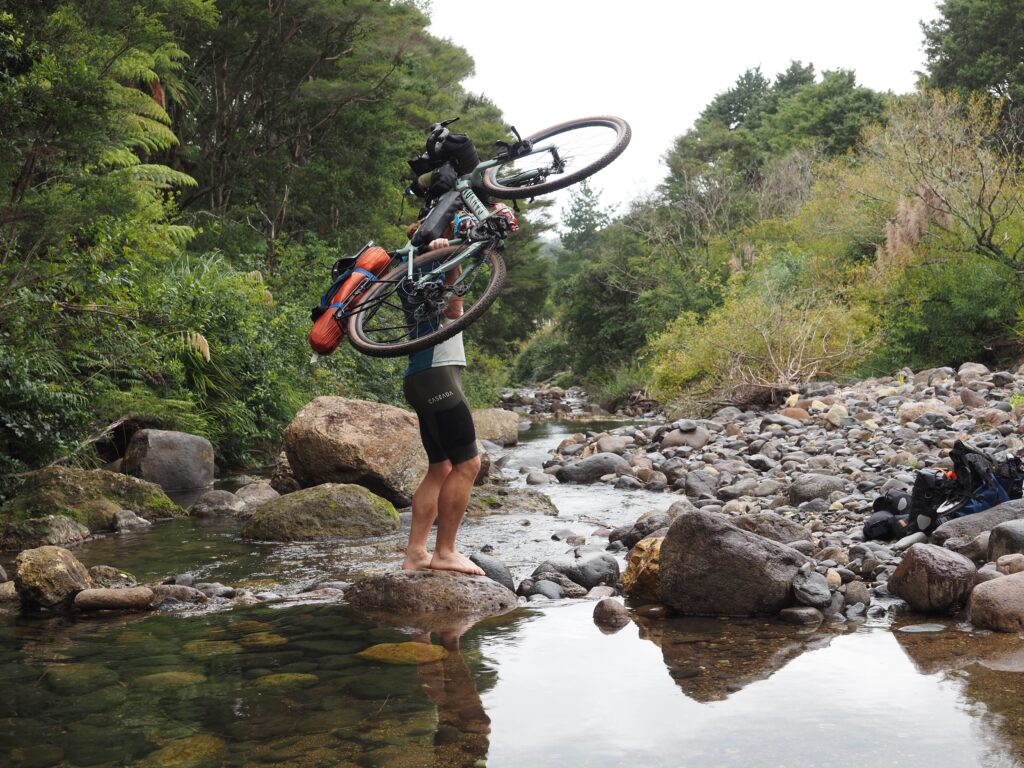
    What began as a peaceful day soon turned to madness. A rustic path led them onward, but it was no path at all—it was a river. With great effort, they carried their bags and bicycles, wading through the waters like pilgrims seeking dry land. And when at last they reached the road, they thought their trials were over. But lo, the dreaded State Highway 25A awaited.

    The trail that suddenly turned into a stream

    The trucks were relentless, the shoulders of the road nonexistent, and the climb unending. Sweat poured, curses were uttered, and when at last they reached the top, there was no view to reward their suffering, a true test of their faith. But then, the descent came, and with it, relief.

    The road changed, the land flattened, and cow pastures stretched as far as the eye could see. And though the rain came, they rode on, until at last they arrived at a place of rest—a humble tavern where Guinness flowed, and an orchard of plenty awaited with space for their nightly rest. And thus, they feasted upon apples, pears, and plums, and all was well.

    And so, it was written: the first week was completed, and though there was suffering, there was also triumph. And thus, Alina and Conor cycled forth, into the unknown.

    THE END

  • The kick off: Kiwiburn

    The kick off: Kiwiburn

    We started our trip at an event close to Palmerston North on the North Island of New Zealand. The event is called “Kiwiburn”, a regional “Burn” that is inspired by the principles and ethos of Burning Man. For those of you who have no idea what we are on about, you can read up about the main principles here. And for our Nowhere Burner friends, we would recommend the experience.

    The site, or as they call it here, “the Paddock” is situated next to a forest with a cooling river, rolling hills, massive trees and towering fern bushes/trees; it is a great venue full of summer smells, sheep and new bird songs to discover.

    The event is run 100% by volunteers (including us), which is why we arrived two weeks before the actual starting date. We were part of MPW (Ministry of Public Works) and helped with the build and setting up of infrastructure for the event.

    Our responsibilities included, but were not limited to:

    • Clearing pathways and the forest area
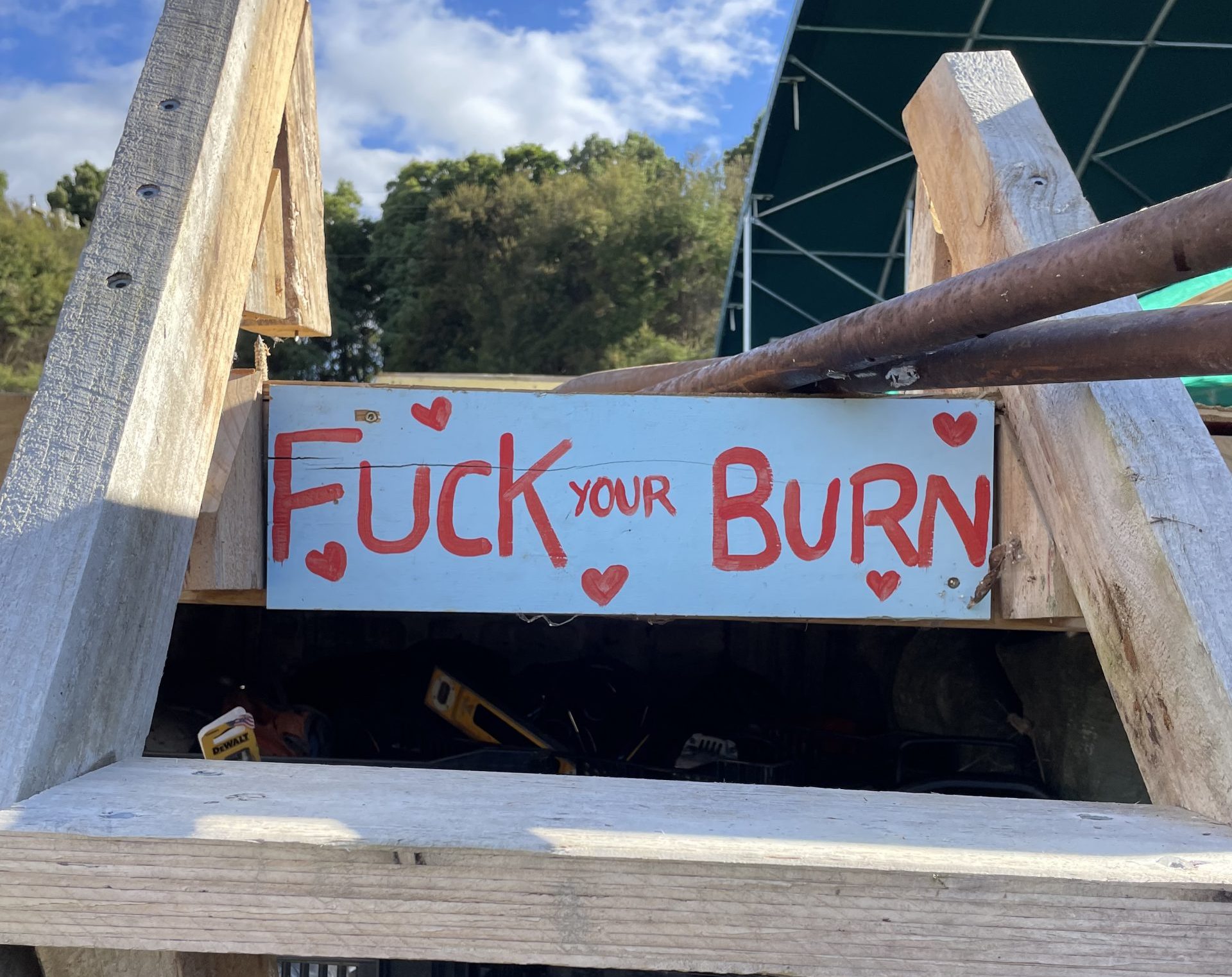
    • Making signs
    • Building Huts and shade
    • Erecting infrastructures
    • Moving portaloos
    • Fixing random things
    • Making handwashing stations
    • Setting up marquees
    • Etc

    Basically we needed to turn an empty field into a hippie paradise. Apart from that we got to be part of a fun crew and build our confidence with a collection of tools, some of which we have never used before (e.g. auger, angle grinders, several types of wood saws and many more).

    Some perks of being part of the crew are a banging crew area with outdoor showers, composting toilets, and plenty of fun times pre-event. All while being fed amazing food. We had a mountain of food that very rarely if ever repeated itself, considering that it was a temporary kitchen in a gazebo, it was fantastic.

    A big part of the Kiwiburn culture are internal shenanigans (which go as far as hot wiring a crane to get your couches back from different crews/camps) and Dobro’s. 

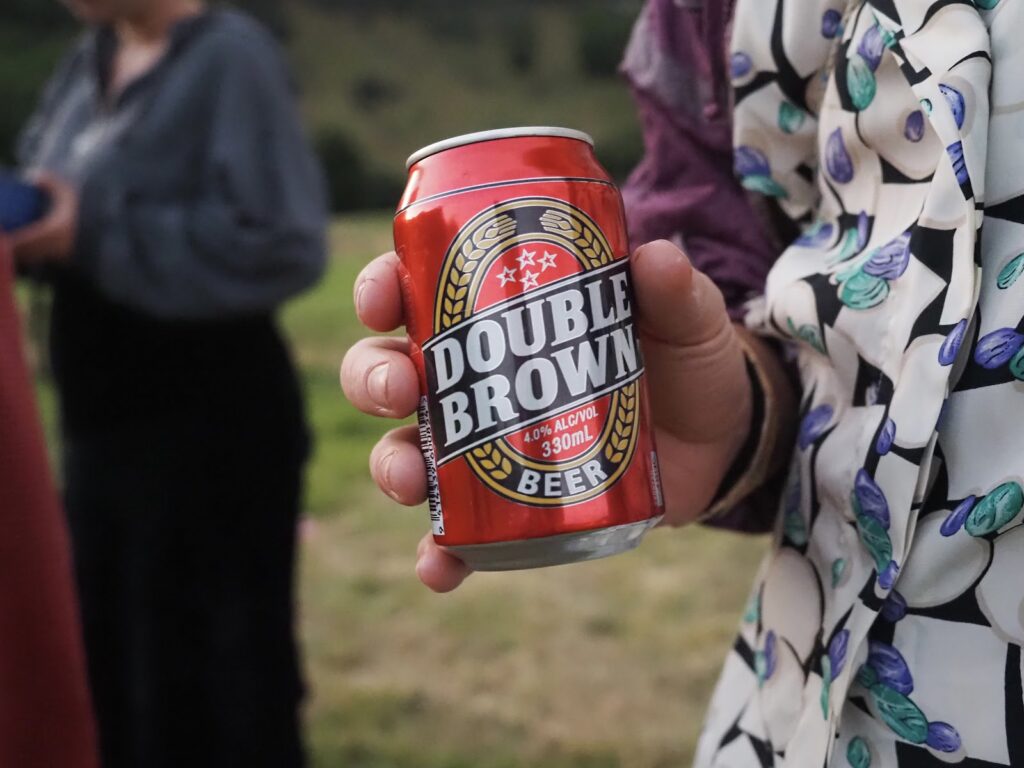
    Leading up to Kiwiburn, we heard many things about Dobro’s, but had no idea what they might be. We have now learnt that Dobros, or Double Browns, are the preferred beverage, as they are cheap, have only 4% alcohol and are “safe to enjoy during working hours”, as well as tasting similar both cold and warm. They can also be used as a “currency” (money ain’t get you far at a Burn).  

    A community BBQ was organised the weekend before the event started to give the locals a taste of what the event is all about. Surrounding farmers and locals, including the mayor, came to enjoy a spit roasted lamb, a renegade show and a small effigy burn (a pheasant within an egg – built by MPW).

    Finally, after two weeks of slowly toiling away and creating a space fit for a 2500 person event, we were feeling very comfortable in our idyllic surroundings… and then it happened, the event kicked off. The once peaceful Paddock that for two weeks was our little safe haven, was overrun by a flock of overly energized hippies. It took us a moment to come to terms with this invasion of our “home turf” that we had worked on with the crew. 

    We quickly learned that Kiwis have colossal camping set ups, the likes of which we have never seen before. Gigantic gazebos, tents on top of trucks, entire living rooms and kitchens sprawled all over our lawn, some even brought their rugs with them. The local sheep were firmly displaced and our views were greatly reduced as the tent city sprung up around us. Where once it was just us and a scattering of sheepish sheep, there were new highways of (semi-)naked hippies, flashing lights, sounds, and frantic energy.

    There was a time when we were very proud of our little camp, that we managed to erect with a convoluted system of mismatching ropes, tree branches, and old tarps that we had scavenged from the work yard. However our immediate neighbors were quick to show us how it was done. Their compound made our carefully constructed camp look more like a rundown shelter. Given our limited resources it was clear that we were the plebs of the Paddock. We shared the space with friends from the build and christened it “Shanty town”.

    The event had started and it was time to explore and indulge in its offerings. Officially it ran from Wednesday to Monday. It is a free form event –  no headline acts, no corporate sponsorships, no real security, no money, and no rules per-say. It is up to the participants to provide the entertainment, to share their knowledge/food/drinks/vibes/music and allow the event to organically take its own shape and energy.

    For us a typical day included some time in the forest, dipping in and out of the river, reapplying heavy duty sunscreen (the UV is extra strong here, due to a hole or two in the ozone layer), attending a workshop or two, checking out the artwork, handing out shots of tequila and verdita (shout out to Ian and Sarah), getting dressed up and then dancing late into the night.

    The pinnacle of the event is “The Burn”, which is the burning of a huge effigy on Saturday night. Prior to the event the effigy crew had worked day and night to build a towering art structure (12 meters tall), made out of recycled bamboo and pallets.

    The burn was a massive spectacle, including fireworks, fire dancers and flame throwers. It was by far the biggest fire that we have ever seen, with bright flames of green, blue, crimson, and gold, that soared high into the starry sky.

    The rain came down not a day too late, as the event was coming to an end. We watched hoards of people abandon the paddock, which led to the phenomenon called “Collexodus” – crew members collecting excess snacks and alcohol from the participants who were making their collective exodus. We were now fully loaded again and ready for the pack down. Given the scale of the event it was really remarkable how quickly the paddock was evacuated and how clean it was left. There was just enough time left for some days of hard work and one last crew party. Then we said our goodbyes and made the nine hour bus journey back to Auckland. Time to rest up, wash and get ready for our big adventure on two wheels.

    Wish us luck!

    Sound track to the month:
    You’re welcome – Moana

    London bridge (oh shit) – Fergie

    Unwritten – Natasha Bedingfield

  • How to exploit your friends and effectively leverage relationships in 2025

    How to exploit your friends and effectively leverage relationships in 2025

    2025 is here! Start the new year on the right foot and sow your seeds of emotional manipulation now!

    If you are planning a trip in 2025 or beyond, we highly recommend that you start developing your friendships now, in order to harvest their fruits when the time is ripe for you to leave.

    Exploiting your friends can be a great way to raise badly needed funds. It can also provide much needed storage space while you are away and if you do it right, it can even be fun.

    “Garage sale: Happily exploited friends”

    We have spent the last few months leveraging our strategically important relationships, and reaping the benefits of their resources and insecurities. Here are some simple guidelines to follow and some tips and tricks we picked up on the way.

    Step 1. The mark:

    All good cons need a good victims, and good friends make good victims…

    The stronger the emotional bond that you can form with your victim the better. When the time comes to leave, the higher the victims perception of the relationship, the more exploitable/useful they become.

    A good victim could take literally years of work. We know that at times it can be a slog, but just keep your end goal in mind and the time will fly by.

    What really worked for us, was to find common interests with our victims. Developing friendships can be less bothersome if you couple it with parties, frisbee, festivals, excessive-alcohol, exercise, BBQs etc.

    Everyone is different and our approach will not work in every instance, but if you stick to our advice you should start to see the results almost immediately.

    Step 2. The set up: 

    “O.K. I have my friends, now what?”

    At first having friends can seem rather pointless, but trust in the process and you will be making monetary gains in no time.

    To reap your just rewards, you need to get creative. 

    Luckily, most people are pretty one-dimensional and very susceptible to food and alcohol. We recommend herding your friends together in your house and regularly plying them with varying delicacies.

    There are many ways to benefit from your newly found friendships. For us money and storage were top priority, which gave us a clear objective.

    Next up you need to lay your trap:

    • Plan a going away party.
    • Send out your invites.
    • Arrange your house to maximise your sales opportunities.
    • Obscure the exits.
    • Remove any furniture that might allow them to rest (studies show that a slightly agitated mark can spend 15% more then an comfortable one).
    • Alcohol.
    • Small talk.
    • Sell, Sell, Sell.

    Pro tip: Serve your food late, to keep your audience captured.

    Step 3. The con:

    Now it is time to spring your trap. Harass people into buying your unwanted items and guilt them into storing your possesions. The more persistent you are the better. 

    This is also a great way to measure the success of your friendship, and a noteworthy K.P.I.

    Pro tip: It can be helpful to slip in a few actually valuable and practical items to make your friends forget the caveat of their spendings and commitments.

    With some luck, you should now be ready to jet off on your self indulgent trip, while your friends spend the next year or so realising that the items they bought were a mistake and that their very limited storage space has been drastically reduced, but it won’t matter to you, because you are literally on the other side of the world.

    Dedicated to our dear friends – we love you and appreciate all your support and help!

    Conor & Alina